Painting of Scenes in Mongolia, ca. 1905
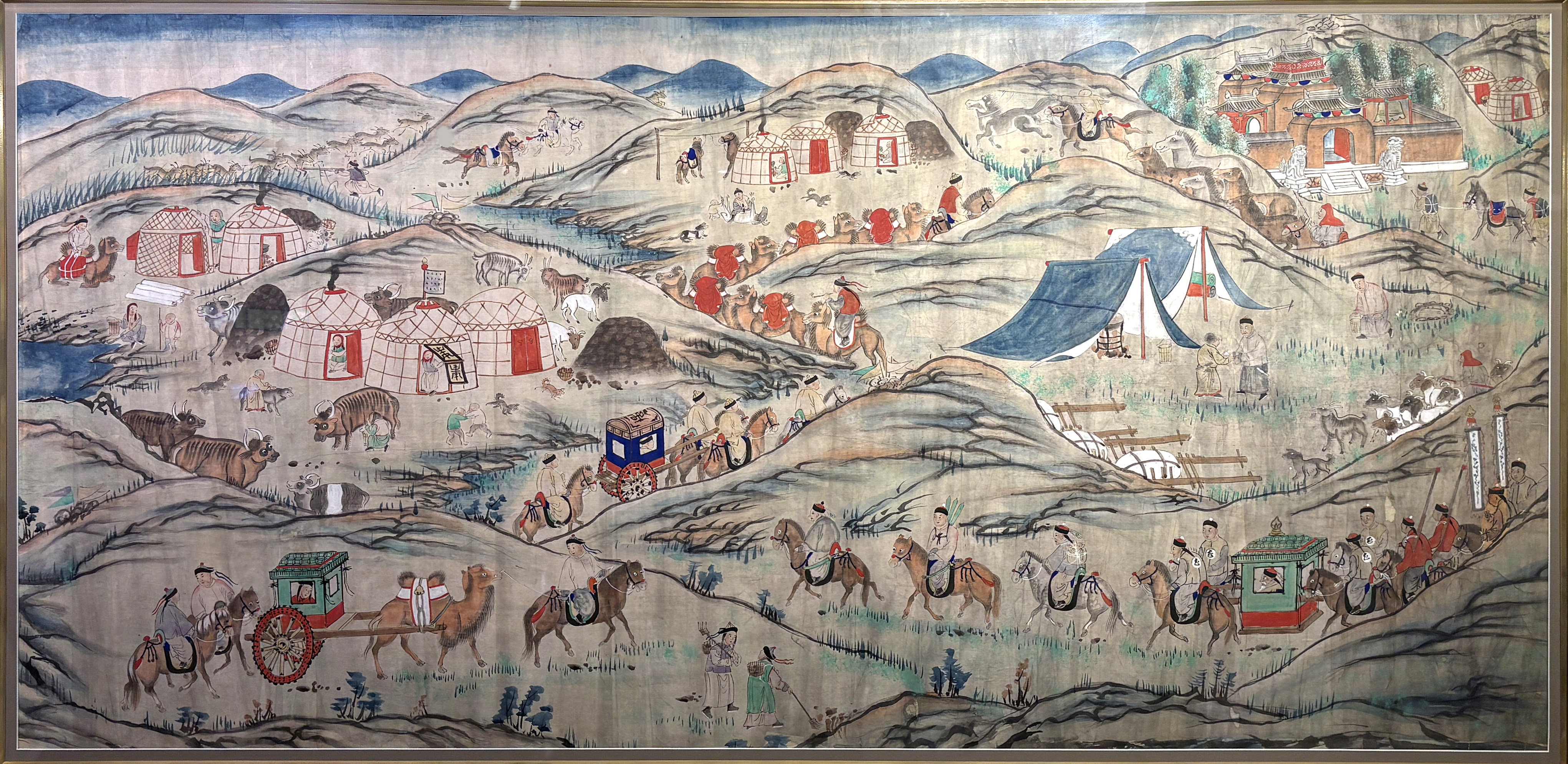
Painting of Scenes in Mongolia [Click image once or twice to enlarge, back arrow to return.]
The painting presented here was one of six to ten watercolors on paper measuring a little over four by two feet brought to the U.S. in 1906 by James Hudson Roberts in the form of rolled up scrolls. He had probably obtained them while traveling in Mongolia near his mission in Kalgan, China, in 1905. One of these scrolls, which although darkened at the bottom and right edges retains most of its original color, is presented here along with JHR's description of the activities that it portrays. One other version that exists in the Roberts family is shown at the bottom of this page and there were no doubt other variants.
These scrolls display many of the features of a style that emerged at the beginning of the 20th century under the name "Mongol zurag" (Mongolian picture). Rooted in a Tibetan Buddhist pictorial tradition and incorporating Chinese and Indian influences, this style featured ultra-fine brushwork, bright colours, flattened perspective and themes drawn from everyday life. The classic early masterpieces in this style were four works now called "One Day in Mongolia" created by Baldugiin "Marzan" Sharav around 1911 for the ruler of a newly independent Outer Mongolia, who was building a new palace at Urga (now Ulaanbaatar). Without using Western-style linear perspective, "One Day in Mongolia: Summer" and "Autumn" present massive, sprawling panoramic bird's-eye views that portray weddings, herding, festivals, felt-making, and other activities of ordinary nomadic peoples across the steppe. "One Day in Mongolia" may be seen here on Wikimedia. The Roberts scrolls, which date to no later than 1906, indicate that the Mongol zurag style was already in use at the grassroots level before the master began his works. JHR refers once to the artist as Chinese, but the scenes and culture appear to be almost entirely Mongolian.
EXPLANATION OF PAINTING OF SCENES IN MONGOLIA
(The scenes are described in groups.)
Written by James H. Roberts,
Hartford, Conn., Mar. 20, 1911.
Page designed by James N. Roberts,
Built by Stephen S. Roberts.
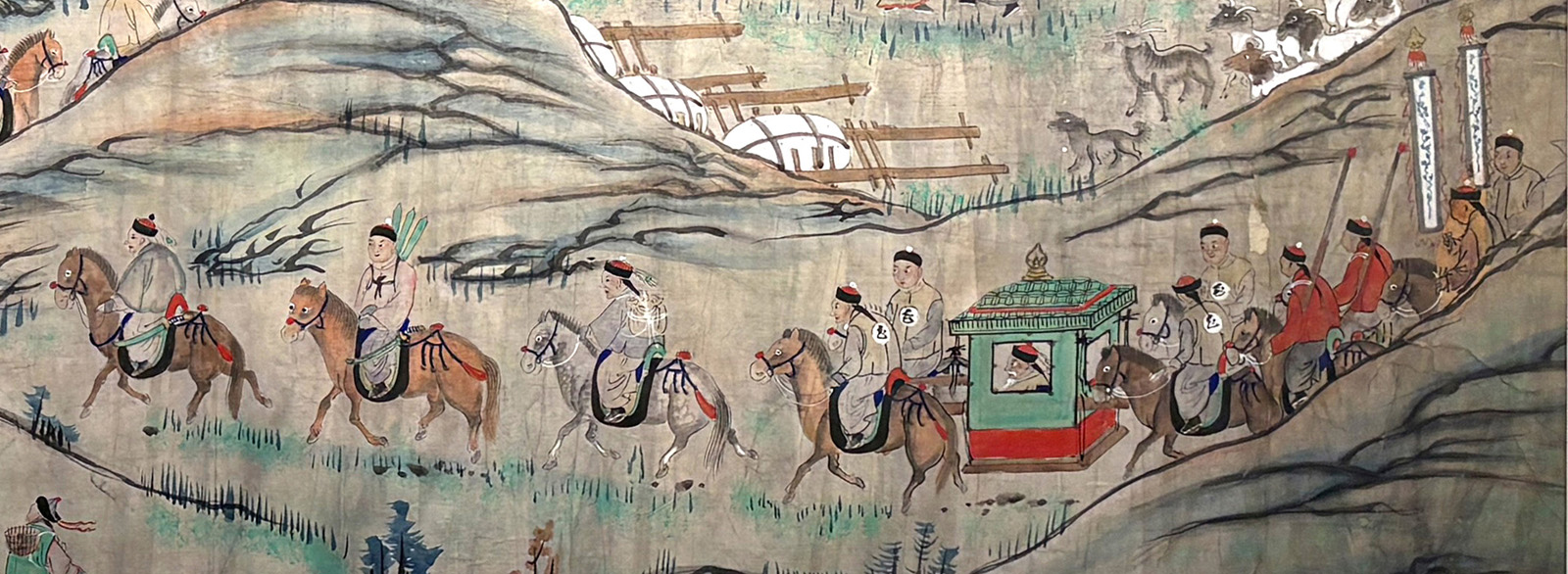
1. The Procession in the right lower corner: a magistrate traveling in a large sedan chair or "mule-litter", - the shafts in front and rear being carried by the saddles of four horses, on each of which a servant rides. Three horsemen lead the way, the rear one having on his back a bundle of letters wrapped in yellow silk, - for that is the way in which official mail is carried. Behind the litter are two horsemen with guns, to defend the Chief, and two with banners setting forth his rank and honors. They go as fast as they can make the horses run, and have a new relay of horses each twenty miles. The official, who from his view-point is riding in luxury and grandeur, must get well shaken up!
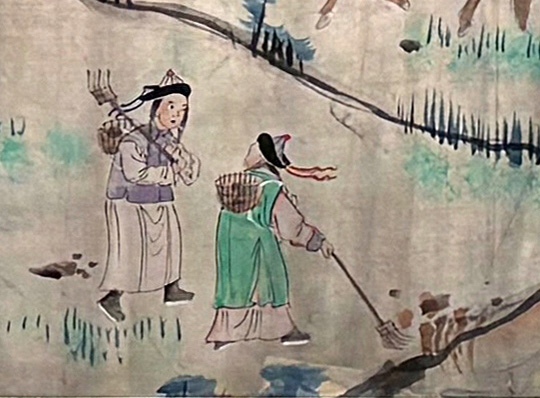
2. In the middle of the bottom of the picture, two Mongol women are gathering fuel from the ground with forks, and throwing it over their shoulders into the baskets on their backs. The fuel consists of the dung of cows, horses and camels, dried in the sun and wind. It is the only fuel in the vast plateau of Mongolia, and is piled up in black heaps near the tents. The size of these heaps indicates the number and industry of the women.
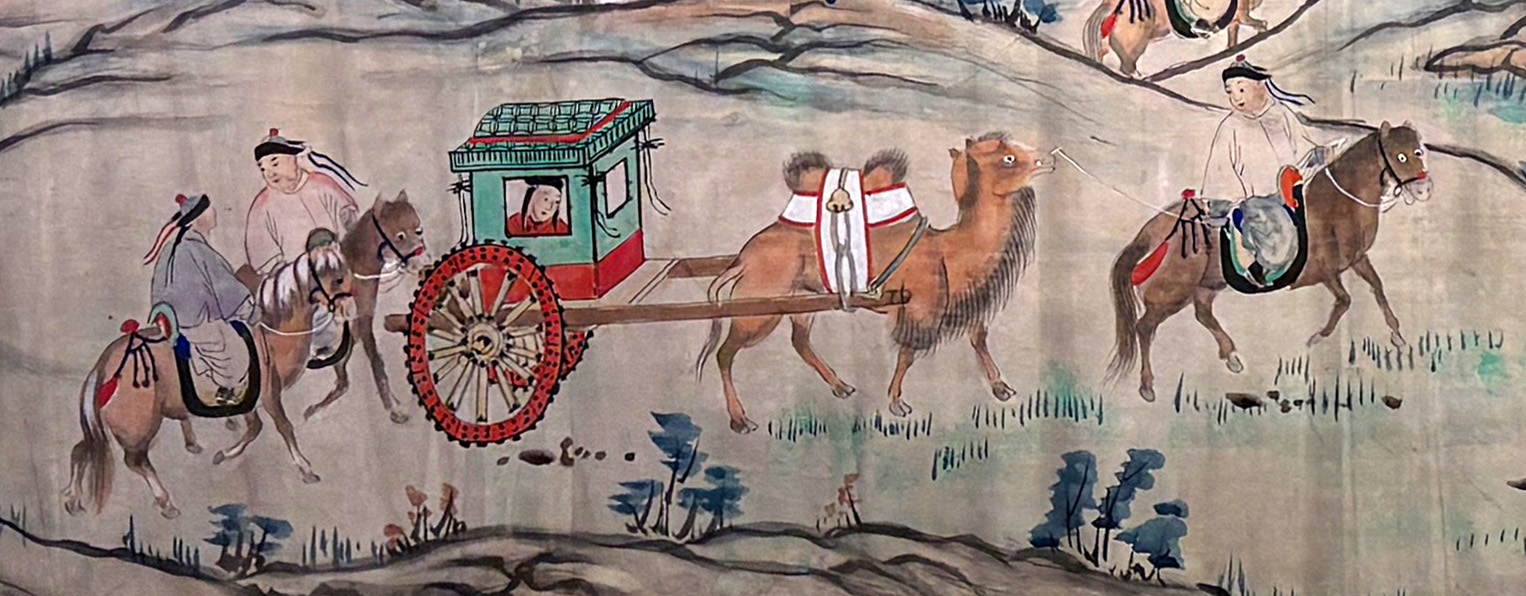
3. In the lower left-hand corner is a camel-cart. The camel is led by a man on horseback; if not led, he would not go where desired. The man leads him by a weak camel's-hair rope fastened to a wooden peg put through the cartilage of the camel's nose! Notice the harness, by which the camel is fastened to the cart. The body of the cart is generally longer, so that a person can lie down and sleep in it, even when going. The knobs on the rim of the wheel are the heads of rivets, that hold on the wrought-iron tire, and prevent its wearing off too fast, two servants on horses bring up the rear.
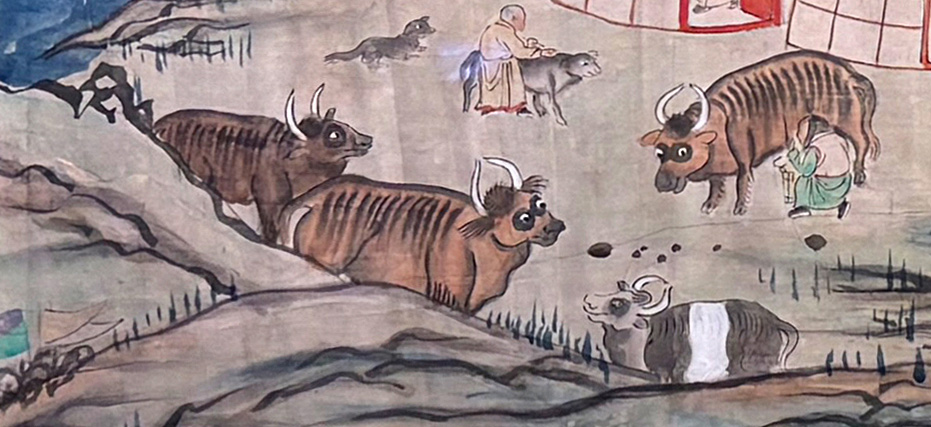
4. Above these, there is a small group of cattle, at the left end of the picture. The cattle are drawn according to Chinese art, and look like buffaloes, - for buffaloes are used instead of cattle in central and southern China.
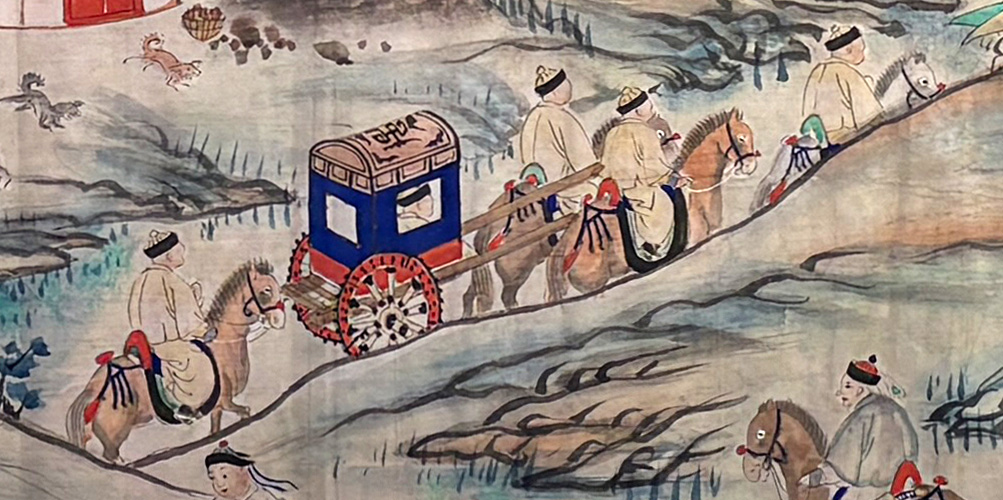
5. Near the middle of the picture, there is a dark blue cart, of the style called the "Peking cart". The thills are drawn by the saddles of two horses, each carrying a rider; and an "outrider", or servant on horseback goes before, while another follows, to present a stylish appearance. The mountains are not so steep in Mongolia as they look in the picture, and a cart can be driven easily to the summits of most of them. Neither is the population as dense as depicted; for it is not over (.65) sixty-five hundredths of a man to a square mile, and one must imagine miles of prairie land between each two groups in the picture.
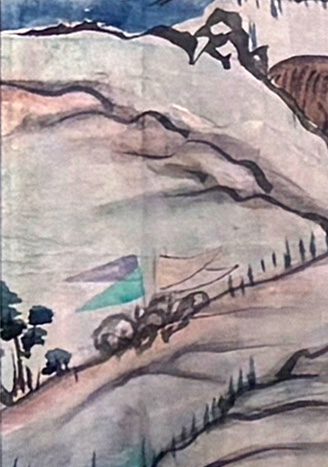
6. At the left edge of the painting, below the pond, there are flags on an altar of stones on a hill-top, where the spirits of the "high places" are worshipped. As the flags flutter in the breeze, they pray automatically; for they are called prayer-flags, and are put there for that purpose. The Chinese artist makes the wind blow them in all directions at the same time!
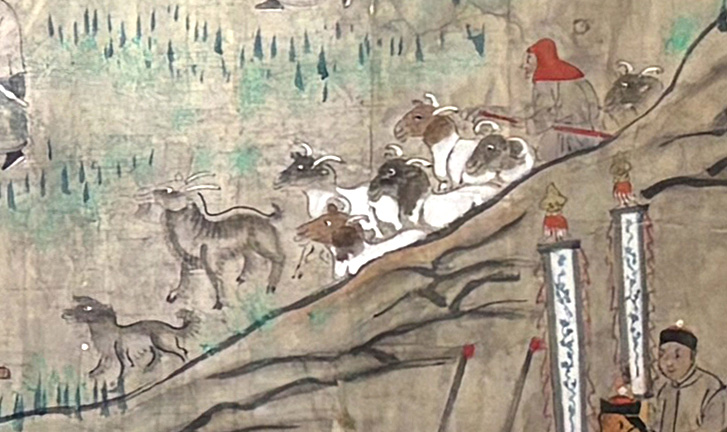
7. At the right edge of the picture, above the procession, is a herds-man with a flock of sheep and goats, the dog running in front. The goats, being of an enterprising disposition, lead the sheep to find good pasture. The shepherd carries two poles, for fighting wolves. According to the program, when the wolf seizes one pole with his teeth, the shepherd whacks its head with the other stick.
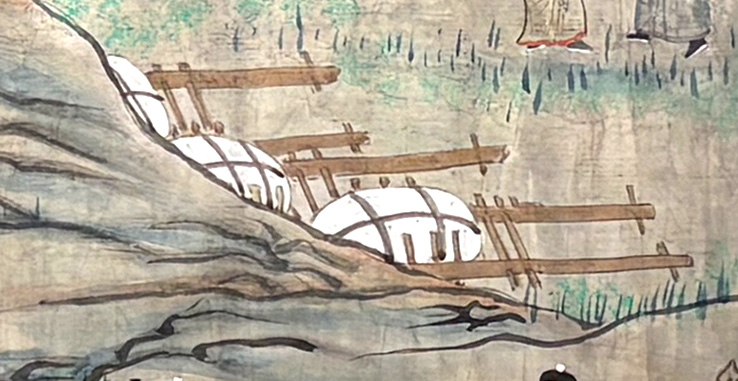
8. At the left of the sheep, there are some ox-carts loaded with crude salt or soda, done up in corn-stalk matting, tied with ropes of camels' hair. Such carts are seen in caravans of hundreds together. From these, the oxen have been driven out to pasture. Unfortunately the wheels of these carts are not in sight. They are made of pieces of wood mortised together, and held together by wedges, which frequently fall out. When possible, water is poured on the wheels, to swell them up. The wooden rims do not pretend to be circular, and the carts jolt fearfully. A cart consists of a ladder laid on an axle, which turns around with the wheels. Often the cart is pulled off from its wheels and axle, and falls on the ground.
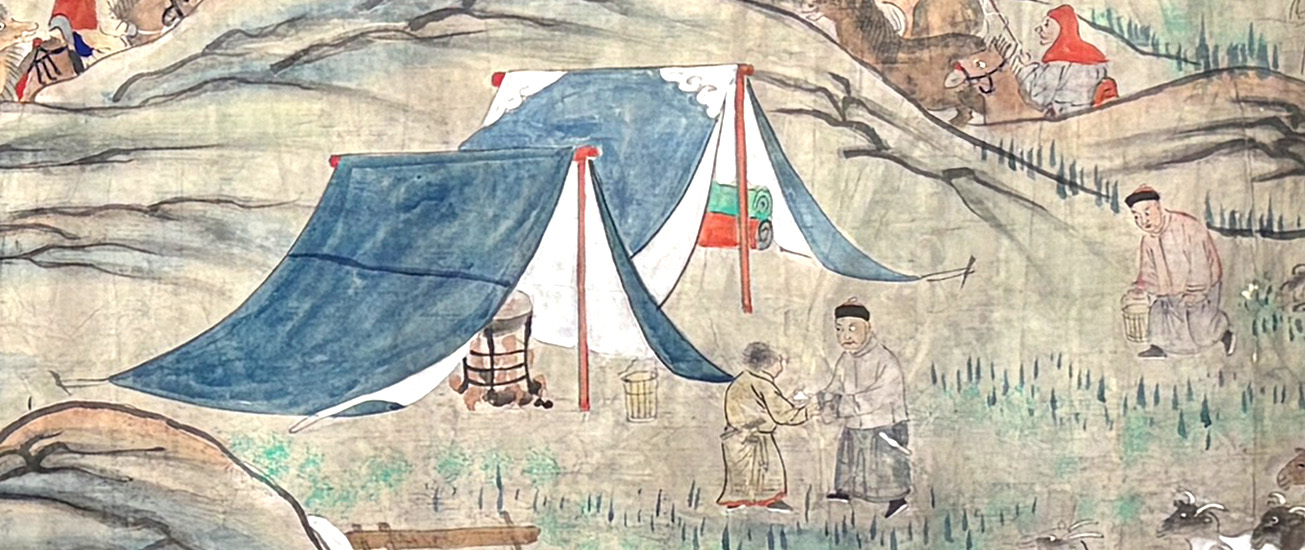
9. Above these ox-carts and sheep, are two Chinese "traveling tents" (of blue cloth), in one of which are seen rolls of bedding, - and in the other, a large iron pot over a fire enclosed in an iron frame which serves as a stove. At the left of the tent-door is a basket of fuel, and at the right is a waterbucket. The owner, a Chinese merchant, is greeting a Mongol lama or priest, not by shaking hands, but, according to the custom of the country, by exchanging snuff-bottles. Each must smell, or at least pretend to smell, the other's bottle. This is a custom of great importance in Mongolia. Back of the merchant, at our right, is his servant, bringing a pail of water from the well.
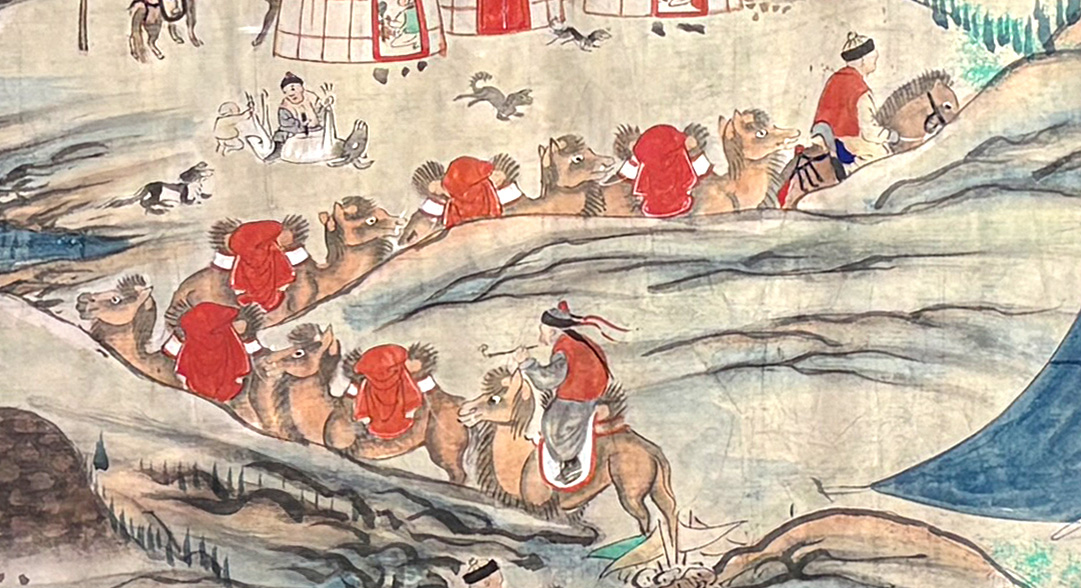
10. At the left of the traveling tents, is a camel-caravan, or fast freight train, carrying goods twenty-miles a day, - whereas the slow freight¬ train of ox-carts goes only half as far in a day. The owner of the camels rides a horse in front, to lead them in the right direction, while his servant rides the rear camel, watching to see that none of the goods fall from the camels, and that no camel breaks loose, and runs away, - as they sometimes do. He can travel, watch the train, and smoke his tobacco pipe at the same time! The caravan goes two and a quarter miles an hour, including the frequent stops. Each camel's peg-¬rope is loosely fastened to the saddle of the camel in front, and pulls out or breaks when the animal stops, so that his nose is not often torn. When the train is broken, the servant must dismount, get the camels together, and fasten them in the same loose way, before the caravan can start again. As the camels frequently pause, to nibble grass or weeds, it is wonderful that they make any progress. Such delays often happen, and the servant is more busy than he looks. The bright red covers on the loads are a fancy of the artist.
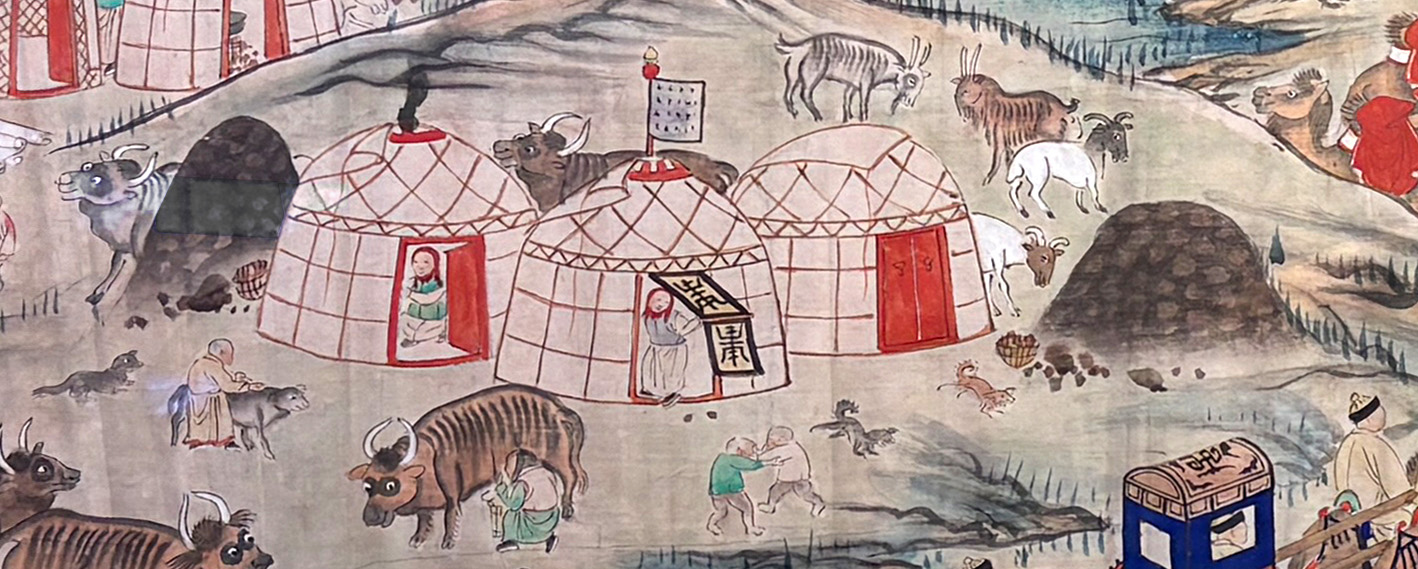
11. At the left of the camel-caravan are three Mongol tents, called yurts by travelers in central Asia. The Mongolian name is gêrê, which means tent or home; the Manchurian name is bao, and the Chinese name "Weng-ku bao" or chang-fang (pronounced j-ah-ng f-ah-ng). Dark heaps of the fuel, called "argol", are seen by the tents; dogs are running out, to warn off strangers; two boys are wrestling, and another boy is holding the calf, while his mother milks the cow. The picture does not do justice to the Mongol dogs, which are large and fierce. Wrestling is a favorite pastime of the Mongols; and always, if possible, one of the wrestlers is a "lama" or priest, and his antagonist is a layman, called a "black man", because of his black hair, - whereas the priest is smooth shaven. The boy in the yellow jacket is the lama. The calf must start the milking, and then be held or tied off at one side, and be allowed to suck several times, - else no milk will be given by the cow. From the kitchen tent, - the smoke is rising; on the central one, which is the reception room or living room, a prayer-flag is fluttering in the wind; and the tent at the right is for guests, and is sometimes used as a store-room. A flap of felt is drawn over the skylight window, to keep out dust or rain. On the hanging screen at the door of the middle tent, is the Chinese word for longevity, which is supposed to bring good luck.
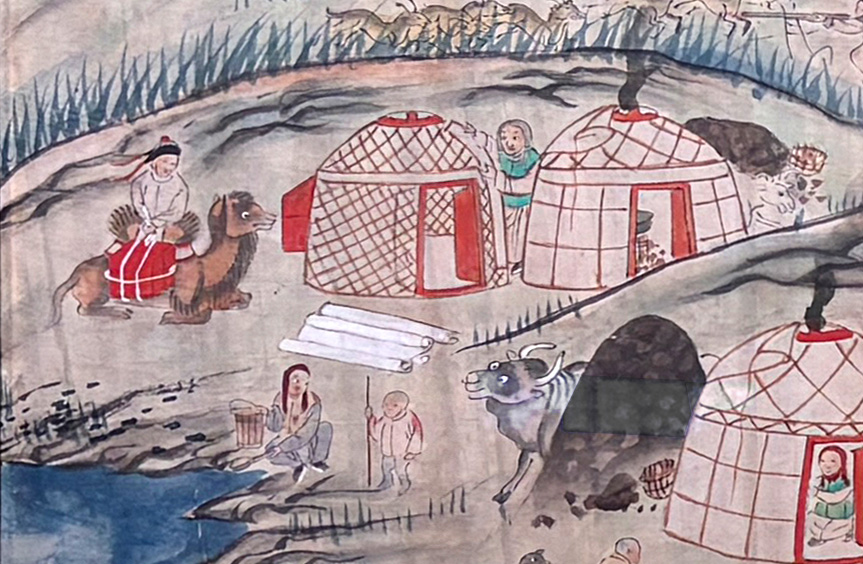
12. Above at the left are two more tents, one of them in the process of construction. The family are moving to this place, the man is untying boxes from the camel, and the woman is covering the lattice-work of the tent with felt, while the girl goes to the pond for a pail of water. A cow is rubbing itself against a pile of fuel. In one tent a fire is made, and the smoke is ascending, while the evening dinner, the one meal in the day for Mongols, is cooking. However, they drink tea and eat cheese whenever hungry, or whenever a guest comes, at whatever hour of the day. On the ground are several rolls of felt, ready to be used in covering the newly erected tent. It should have three layers of felt, breaking joints, to keep out the wind. A well-to-do family will renew one layer of felt each year, putting the new layer inside for good looks, and using the soiled one taken from the outside for camel saddles and other purposes.
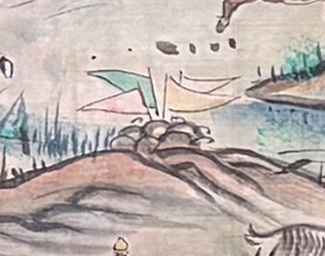
13. At the right hand of the tent in process of construction, there is another stone altar on a hill-top, with prayer-flags flying in the wind, and blowing in every direction.
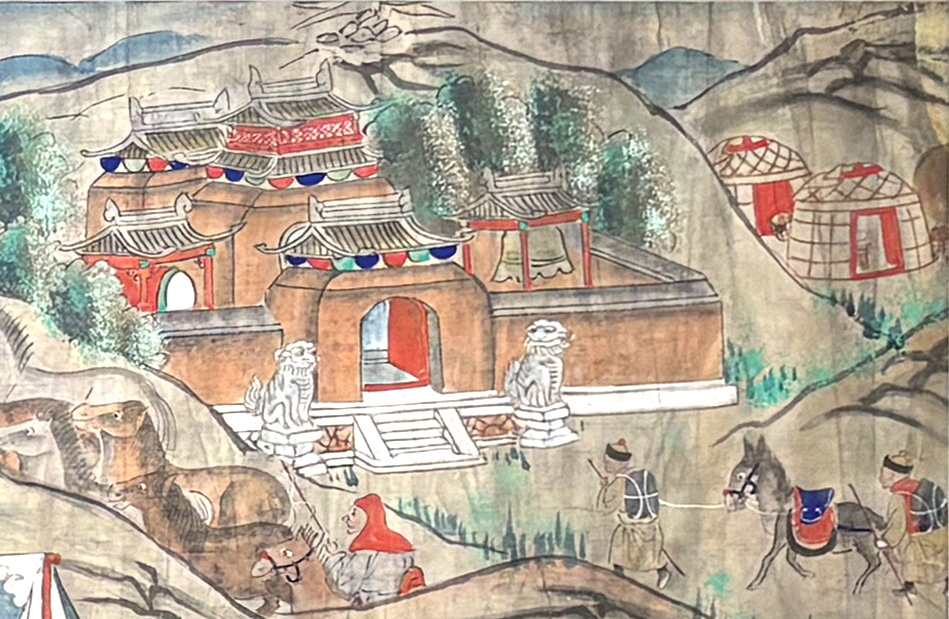
14. In the right hand upper part of the picture, a temple is seen, with two stone lions guarding the gate, with trees which existed only in the imagination of the artist, and with a bell hung in a little belfry on one side of the gate, and a drum on the other side. The bell and drum are struck, when any one is about to pray; for it is said with all seriousness, that the idols might be asleep, and must be awakened, to pay attention! Approaching the temple is a pilgrim, who has dismounted from his horse as an act of reverence, - and his servant is leading the horse. Above the temple is another of the "high places", - an altar with prayer-flags. At the right of the temple is a small encampment, - two tents and a pile of black fuel.
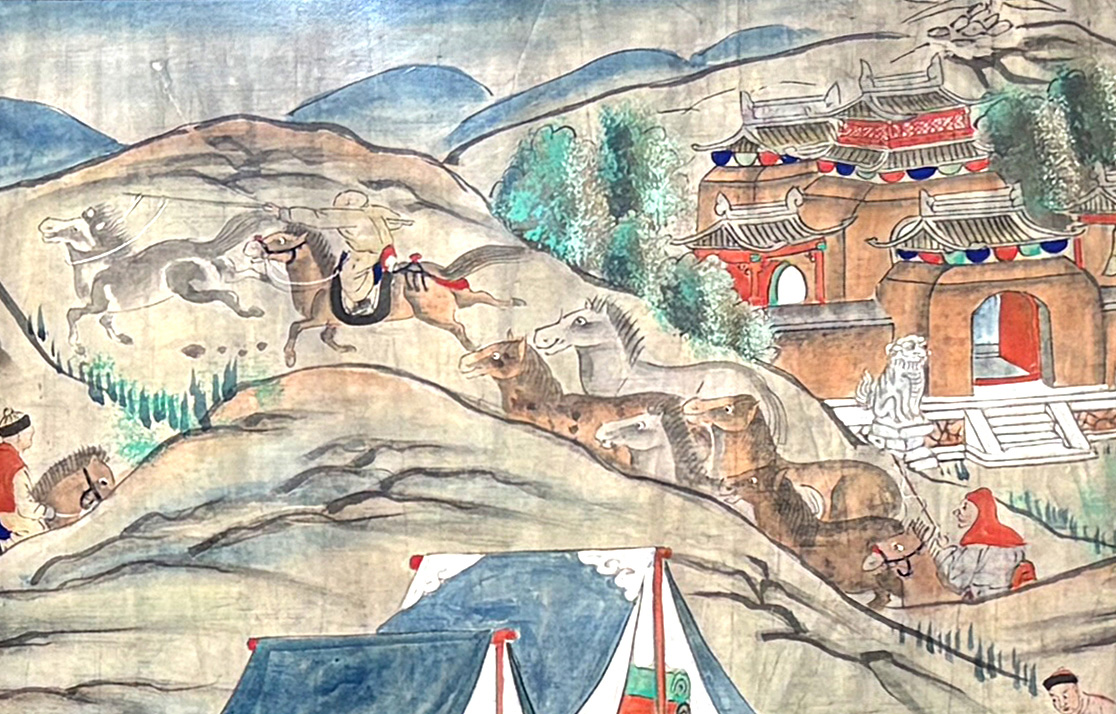
15. Below the temple, toward the left, is a herd of horses, - the herdsman having a red hood fitting closely around his neck, to keep out the wind. He is riding, of course; for he could not do his work on foot, neither would he want to. In front of the herd is a man riding with a long pole and rope, chasing and trying to catch a horse. His yellow robe marks him as a priest. Some priests always wear red gowns and others yellow; to wear the latter color was permitted them, as a mark of imperial favor. The pole and rope are used as a lassoo. The horse must be chased far and wide up hill and down dale, around and around the herd; for the gregarious instinct never allows him really to leave his fellows. One end of the rope is fastened to the end of the pole, while the other forms a slip-noose around the handle. Watching for an opportunity, the man throws the loop over the horse's head. The circus is not yet ended. At the same instant, he slips out of the saddle, and rides behind it, where he can hold on more firmly. The horse that is caught puts on extra speed. It requires a strong and smart man, to use the pole and rope successfully. The chase continues a long time, the man gradually twisting and tightening the rope by rotating the pole, until he chokes the captive horse into submission.
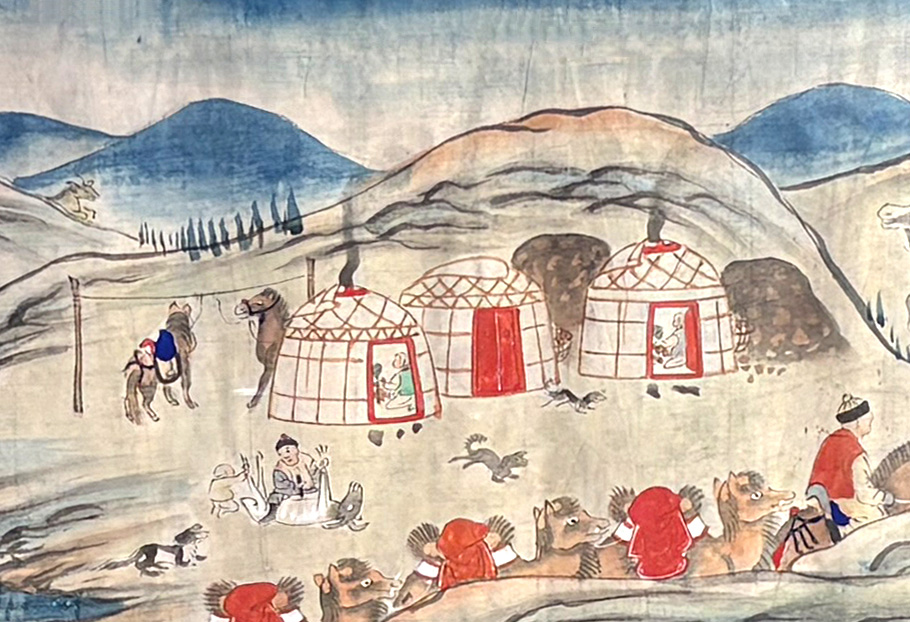
16. At the left of the horse-chasing scene, there is another encampment, with its pile of fuel, three Mongol tents, the middle one having the flap of felt drawn over the skylight; horses hitched at the left; and a man slaughtering a sheep in front of one of the tents. A boy holds the hind legs of the sheep, while the man does his work. The act is almost bloodless, - not as depicted, though the attitude of the man is correct. First he takes a little of the wool over the heart between his knife and thumb, and pulls it off; then he makes a small cut, to enable him to insert a finger; then he pulls and breaks one of the main arteries close to the heart, and the sheep dies almost instantly. It can be cut up inside a tent, without spattering blood on anything, for all the blood is kept inside the skin. The method of hitching horses, shown in the picture, is fine. A strong leathern cable is stretched between two posts, high enough not to trouble the horses' heads. There is room to hitch any number of them, and they can turn and face in any direction, without winding up or entangling their straps. Even a poor man will have two horses grazing alternately, and hitched in turn, equipped with saddle and bridle, ready for a sudden gallop over the prairie. The transportation is cheap, as well as convenient, for the horse needs no shoes nor grain; but the saddle is hard and angular, hard for the rider, until he becomes used to it(?), and apt to injure the horse, unless securely strapped.
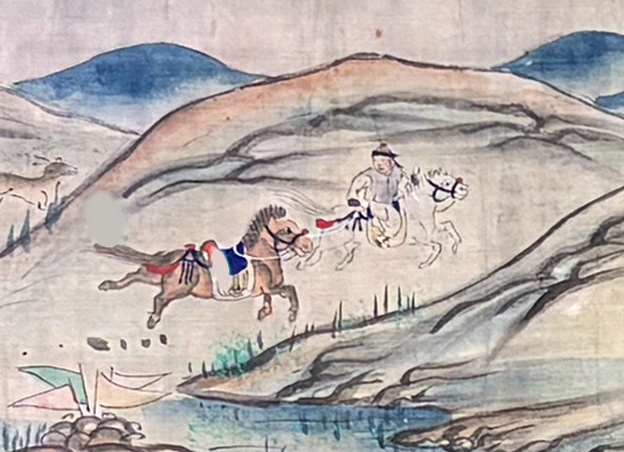
17. Next, at the left, is seen a man with two horses, going as fast as he can. He is going for the doctor. and takes the extra saddled horse, for him to ride coming back.
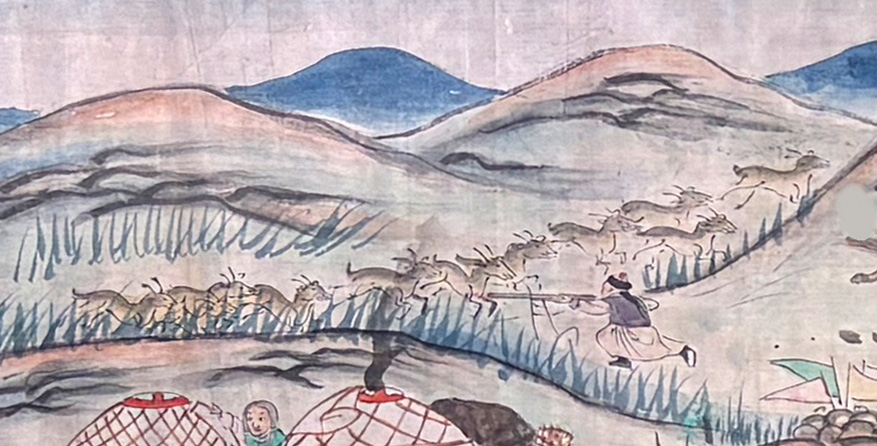
18. Still farther to the left, there is a man shooting deer. To take aim, he kneels down, and rests his gun on a wooden frame attached to the barrel. The curious thing is, that the deer are running toward him, to be shot! Really, the deer are a species of antelope, and are seen in districts remote from dwellings, a few or several hundreds together. They are extremely shy, and very fleet in going. Two men should hunt them together, and, after sighting them, ride by a circuitous route behind hills that will conceal them, until in a favorable position, not between the sun or wind and the deer. One holds both horses, while the other creeps to the edge of the hill, and fires, if not too far from the herd. To make the picture true to fact, all the high grass, bushes and trees, should have been omitted. The high mountains in the distance are a conventional border of Chinese paintings, and are out of place in a picture of Mongolian scenery. The country is not as clean as it appears; but, if the painting fails in that respect, it also fails to show the brilliant profusion of wild flowers in the grass, the warbling of the larks, the glories of the sunset views, and a thousand other charms of the prairie in the summer.
------------- Back to top -------------
Another Version of "Scenes in Mongolia."
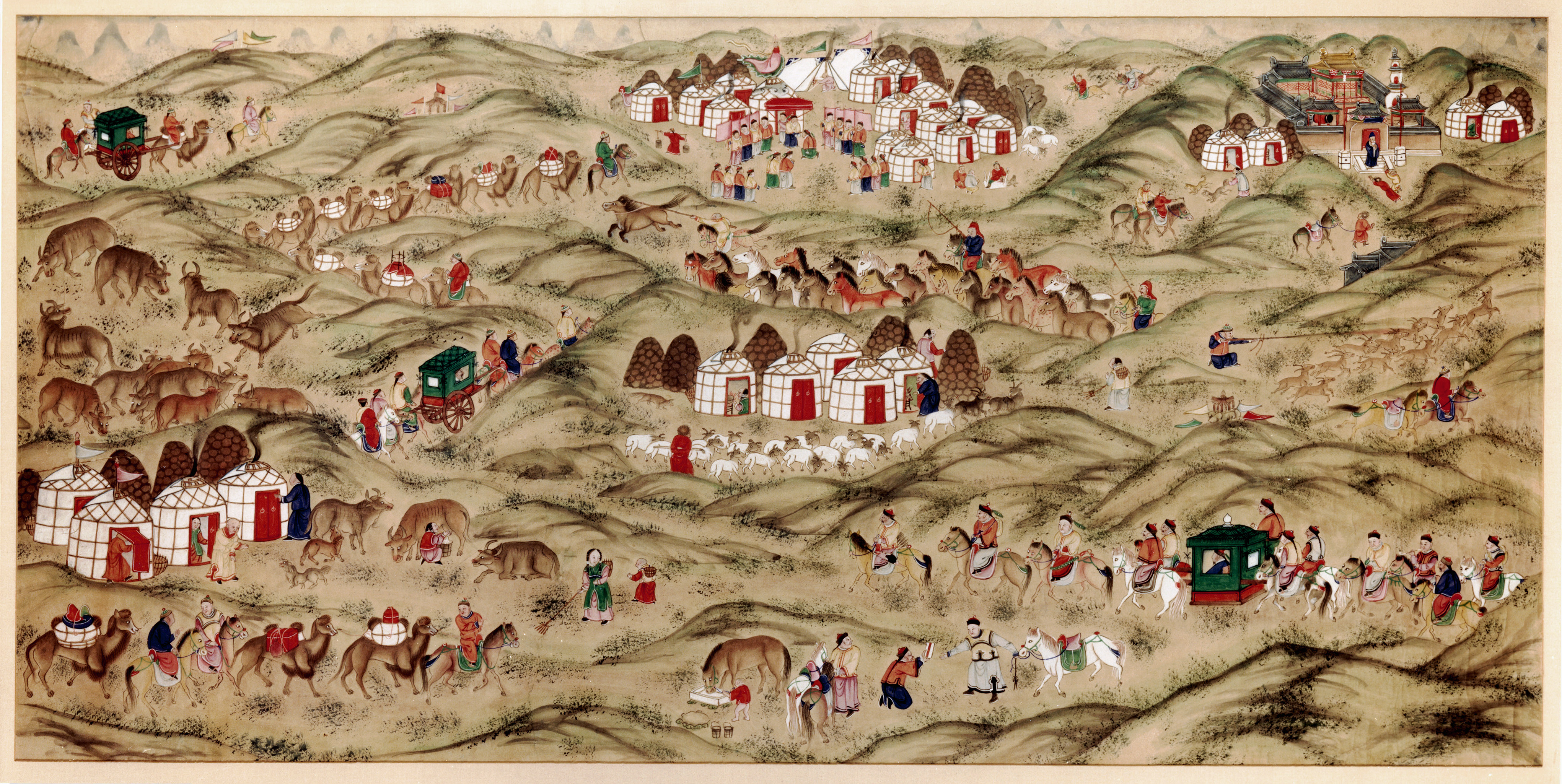
Another Version of "Scenes in Mongolia." [Click image once or twice to enlarge, back arrow to return.]
This is another version of the painting presented above. It is of the same general type and has many of the same details, but some are in different locations and some (notably the two large Chinese traveling tents) are missing altogether. There were probably more versions, but this is the only one now available. Some of the color differences may be due to the much longer exposure to sunlight of this alternate version.