General G. O. Squier (AP-130) Class: Photographs
| These photographs were selected to show the original configuration of this class and major subsequent modifications. For more views see the former NHHC (now Hyperwar) Online Library of Selected Images and the NavSource Photo Archive. |
Click on the small photograph to prompt a larger view of the same image.
|
USS General W. M. Black (AP-135) Near the Mare Island Navy Yard on 4 March 1944. Photo No. 19-N-71199 Source: U.S. National Archives, RG-19-LCM |
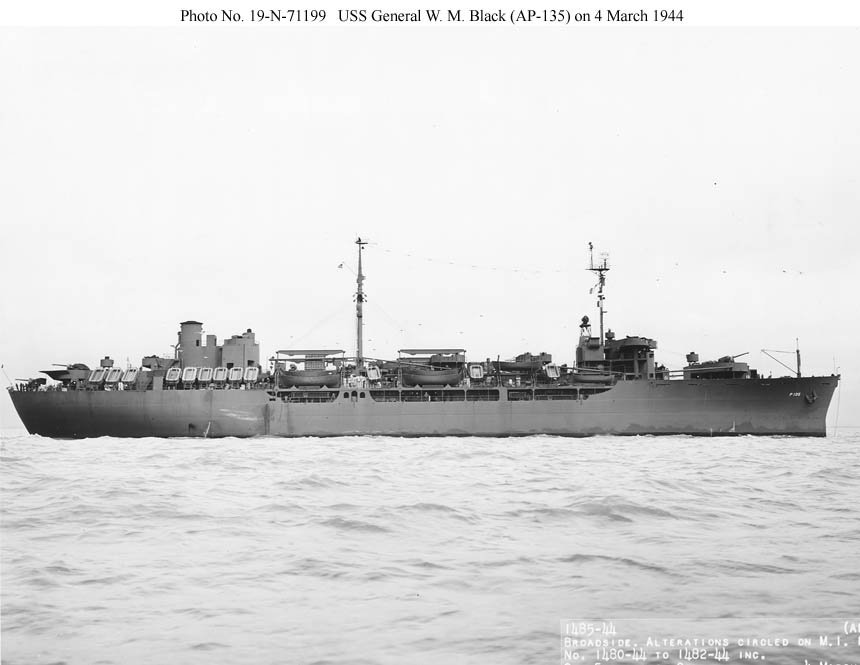 |
|
USS General R. L. Howze (AP-134) Near the Mare Island Navy Yard on 17 February 1944. Photo No. 19-N-71064 Source: U.S. National Archives, RG-19-LCM |
 |
|
USS General J. R. Brooke (AP-132) At the New York Navy Yard on 24 July 1944. Photo No. 19-N-71654 Source: U.S. National Archives, RG-19-LCM |
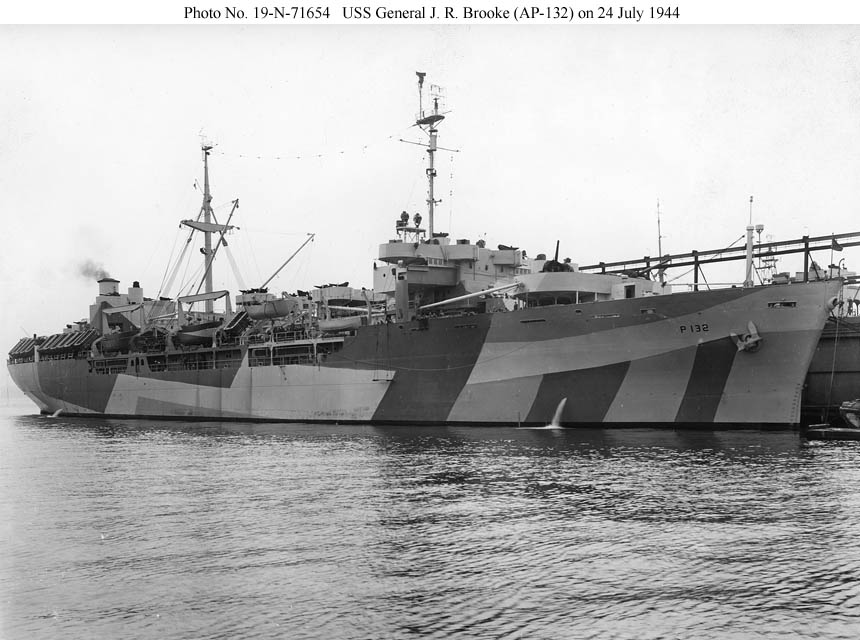 |
|
USNS General LeRoy Eltinge (T-AP-154) Immediately after acquiring most of the ships of this class from the Navy in 1946 the Army gave them austere conversions for manning by civilian instead of Navy crews. The ships had already been disarmed by the Navy. The Navy received this ship from the Army in 1950 in her 1946 configuration with her original Welin boat davits, without the later safety at sea conversions received by many of her sisters. Photo No. Unknown Source: U.S. Naval History and Heritage Command |
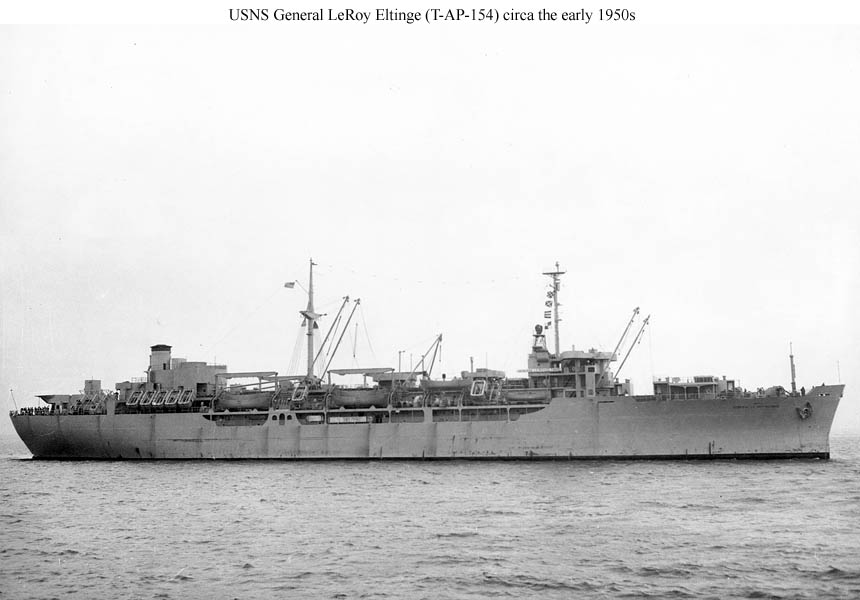 |
|
USAT General H. F. Hodges During or after her austere 1946 Army conversion this ship received a single kingpost amidships to enhance her cargo handling capability. Most ships did not receive this or its equivalent, a goalpost mast aft of the bridge, until their subsequent safety at sea conversions. Photo No. Unknown (Army Signal Corps) Source: U.S. Naval History and Heritage Command |
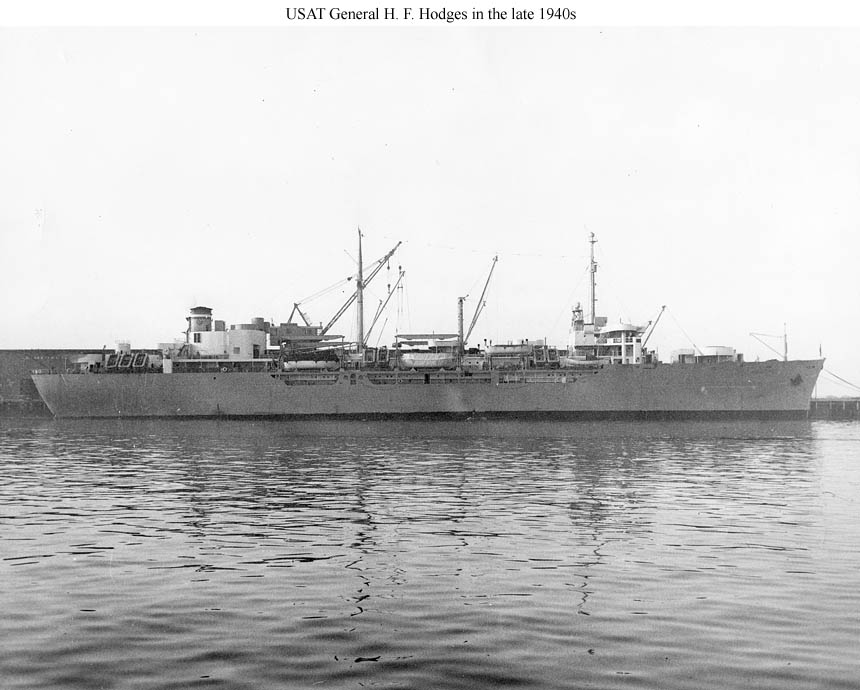 |
|
USNS General W. G. Haan (T-AP-158) The Navy received this ship from the Army in 1950 in her 1946 configuration with her original Welin boat davits, without the later safety at sea conversion received by many of her sisters. The Army, however, did give her a large but light goalpost mast aft of the bridge to enhance her cargo handling capability. Photo No. Unknown Source: U.S. Naval History and Heritage Command |
 |
|
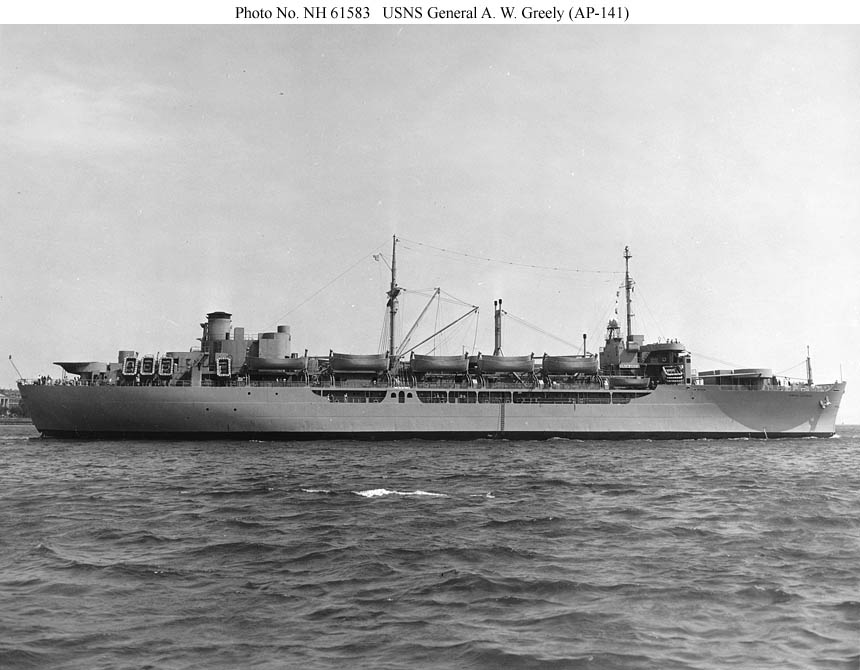
USNS General A. W. Greely (AP-141) Shown in Navy service after receiving a safety at sea conversion, in which the two Welin boat davits on each side were replaced by five merchant type boat davits, substantially increasing the ship's lifeboat capacity. Usually during this conversion, all ships also received an enhancement to their cargo handling capability in the form of a single kingpost amidships, as in this ship, or a goalpost mast aft of the bridge. Photo No. NH 61583 Source: U.S. Naval History and Heritage Command |
 |
|
USNS General A. W. Brewster (T-AP-155) Like many of her sisters, this ship received her safety at sea conversion from the Army before her transfer to the Navy. In the ships like her that received a cargo handling kingpost amidships during this conversion, two nearby galley stacks were extended up the sides of the kingpost, giving the structure a complex appearance. Photo No. None Source: Shipscribe |
 |
|
USAT General C. C. Ballou In Army service circa 1949 after receiving a safety at sea conversion, in which her lifeboat capacity was increased and a goalpost mast was added aft of the bridge to increase her cargo handling capacity. Photo No. Unknown Source: U.S. Naval History and Heritage Command |
 |
|
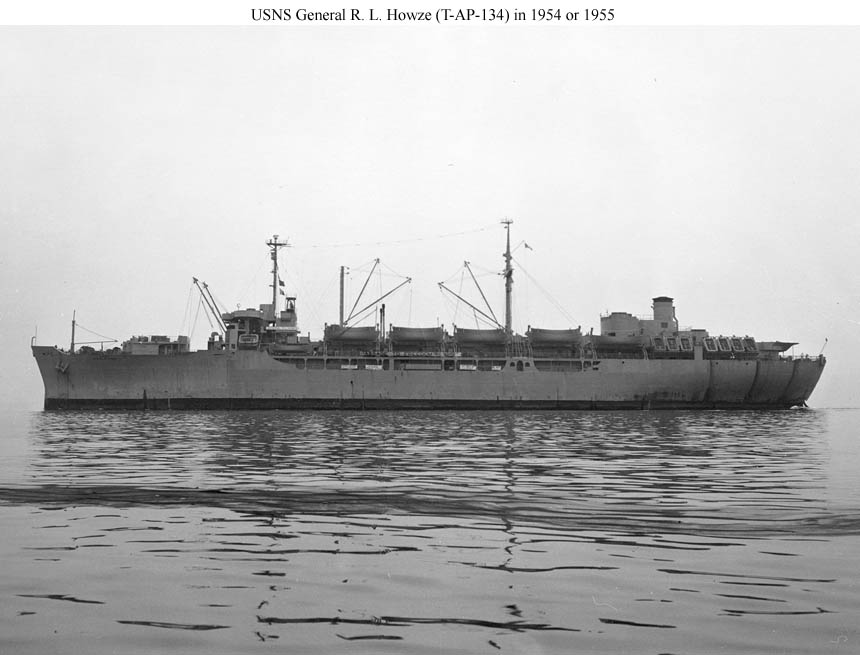
USNS General R. L. Howze (T-AP-134) Shown while participating in the Vietnam "Passage to Freedom" operation in 1954-55. The two cargo booms aft of the bridge are swung from a goalpost mast, here seen from the side. Note the two galley stacks aft of the goalpost. Photo No. Unknown Source: U.S. Naval History and Heritage Command |
 |
|
USNS General Harry Taylor (T-AP-145) Departing Charleston, S.C., on 9 March 1954 after loading troops there. Note her updated lifeboat arrangement and the goalpost mast aft of the bridge. Photo No. Unknown Source: U.S. Naval History and Heritage Command |
 |