Frederick Funston (APA-89) Class: Photographs
| These photographs were selected to show the original configuration of this class and major subsequent modifications. For more views see the former NHHC (now Hyperwar) Online Library of Selected Images and the NavSource Photo Archive. |
Click on the small photograph to prompt a larger view of the same image.
|
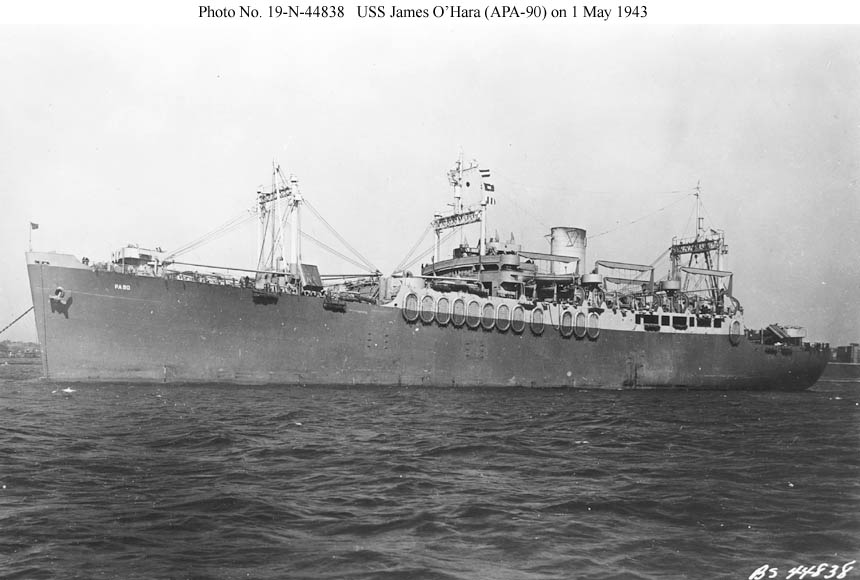
USS James O'Hara (APA-90) Near the New York Navy Yard on 1 May 1943 soon after commissioning. Photo No. 19-N-44838 Source: U.S. National Archives, RG-19-LCM |
 |
|
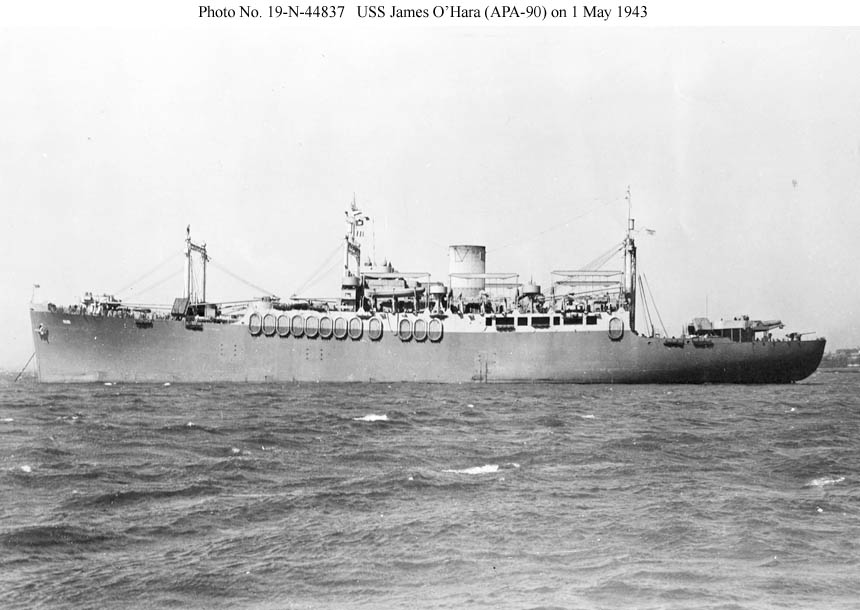
USS James O'Hara (APA-90) Near the New York Navy Yard on 1 May 1943 soon after commissioning. She and her sister initially carried three 3"/50 guns, one superfiring over the 5"/51 gun aft and two on the forward end of the long raised deck amidships. All four positions were originally designed to carry 5"/38 dual purpose guns. Photo No. 19-N-44837 Source: U.S. National Archives, RG-19-LCM |
 |
|
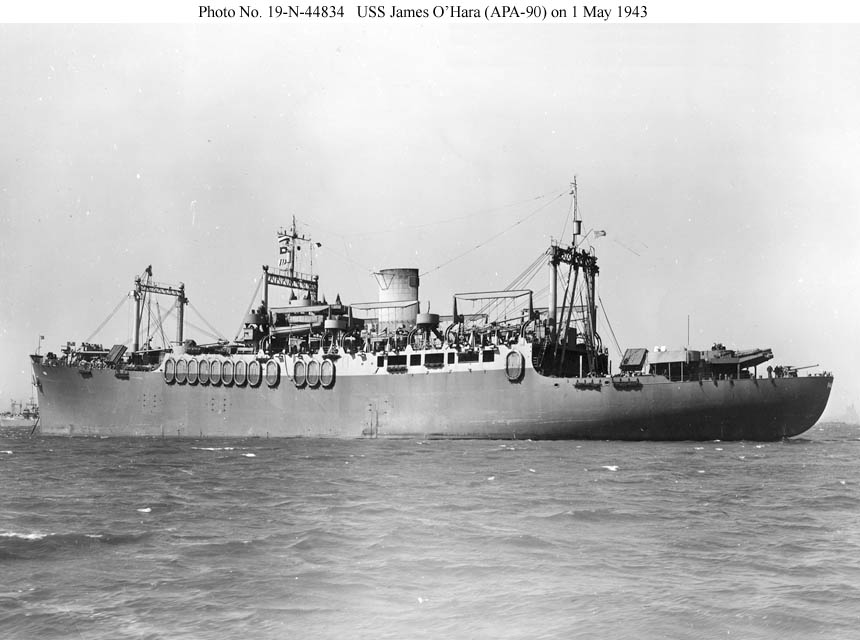
USS James O'Hara (APA-90) Near the New York Navy Yard on 1 May 1943 soon after commissioning. This ship and her sister were standard Maritime Commission C3 hulls extensively modified as Army transports and then as Navy APAs. Photo No. NH 44834 Source: U.S. National Archives, RG-19-LCM |
 |
|
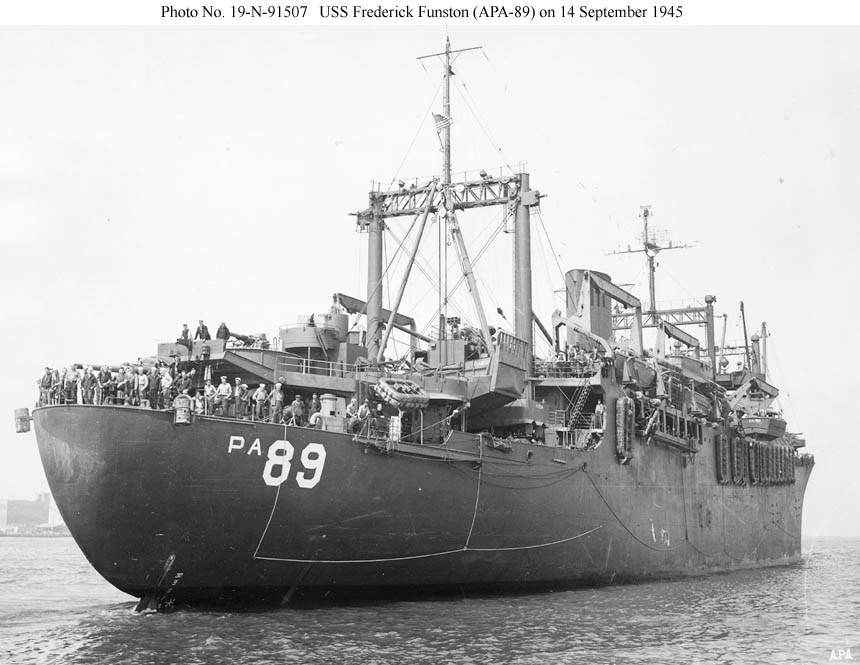
USS Frederick Funston (APA-89) Near Hunters Point, San Francisco, on 14 September 1945. She now has a 5"/38 dual purpose gun instead of the original 5"/51 low angle gun aft and a twin 40mm gun mount in place of the after 3"/50 gun. Photo No. 19-N-91507 Source: U.S. National Archives, RG-19-LCM |
 |
|
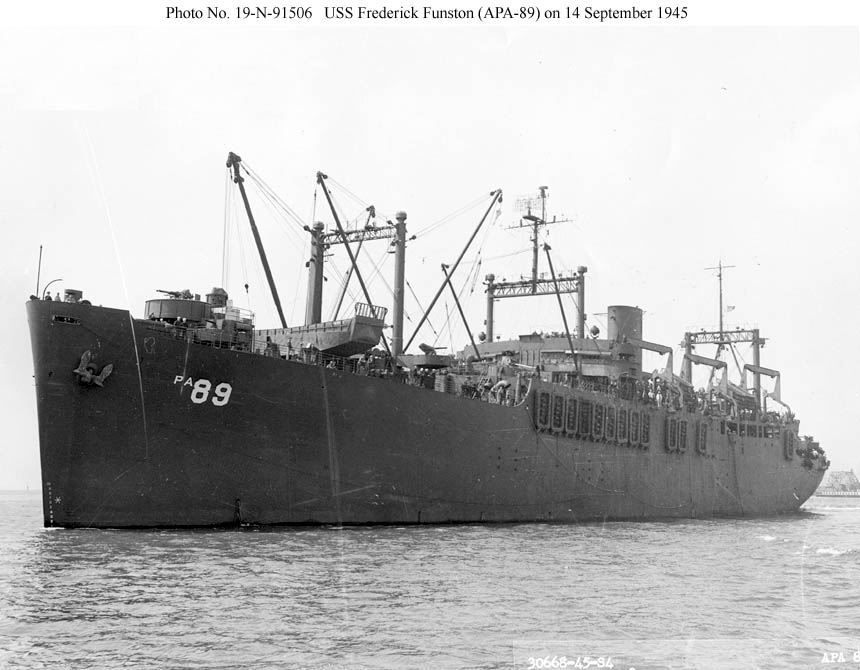
USS Frederick Funston (APA-89) Near Hunters Point, San Francisco, on 14 September 1945. Note the twin 40mm gun mount on the bow and the large LCM(3) landing craft athwartships on deck. Photo No. 19-N-91506 Source: U.S. National Archives, RG-19-LCM |
 |
|
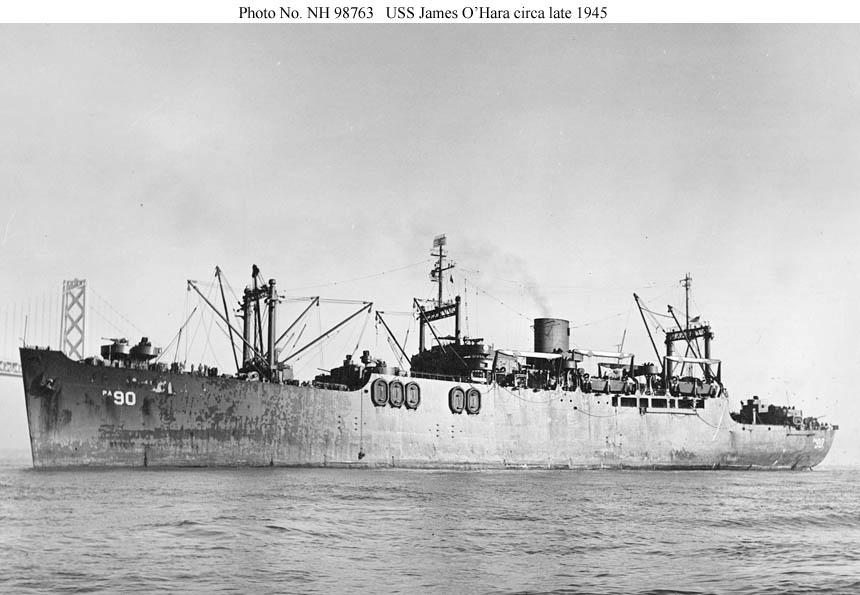
USS James O'Hara (APA-90) At San Francisco in late 1945 or early 1946. Visible guns include a twin 40mm mount on the bow, two 3"/50 guns on the forward end of the amidships superstructure, and a 5"/38 dual purpose gun aft. Photo No. NH 98763 Source: U.S. National Archives, RG-19-LCM |
 |
|
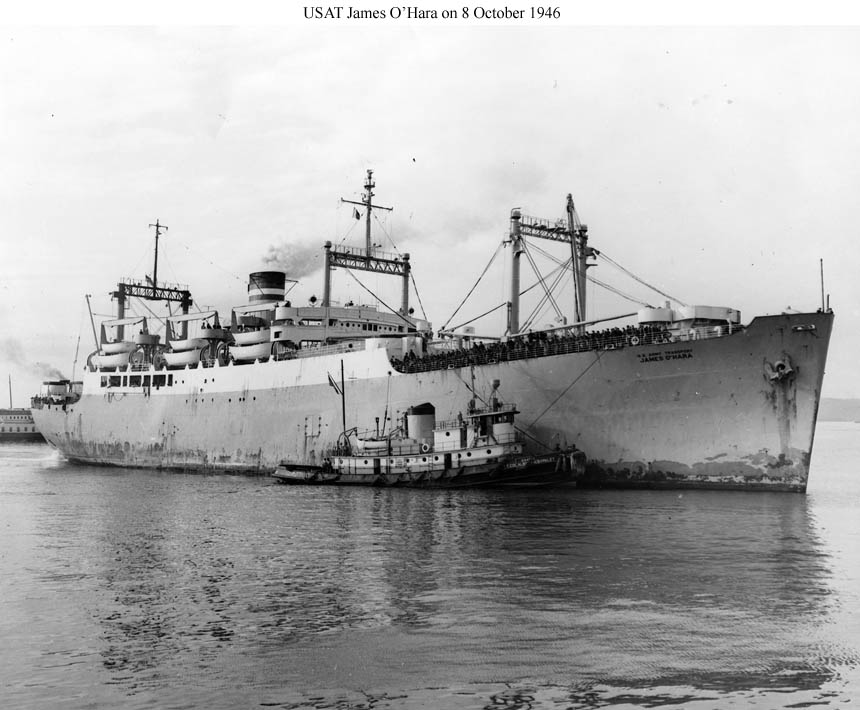
USAT James O'Hara Warping into an Army pier at Seattle, Wash., on 8 October 1946 about 4 o'clock in the afternoon. Her initial postwar conversion to a civilian manned Army transport was austere: she now has civilian-type lifeboats but retains her wartime Welin davits, and is disarmed but retains her gun emplacements on the bow and the forward end of the amidships superstructure. The Army tug is Lt. Col. Albert H. Barkley. Photo No. None Source: Shipscribe |
 |
|
USAT James O'Hara The "flagship of the Seattle Port of Embarkation" circa late 1947. Still in her initial postwar configuration, she began her full conversion to a peacetime transport in February 1948. Some hull and rigging lines in the forward part of the ship have been crudely traced over on this print. Photo No. None Source: Shipscribe |
 |
|
USAT Frederick Funston After completing her full Army conversion to a peacetime transport at the end of 1948. She now shows no evidence of once having been a wartime attack transport. Photo No. None Source: Shipscribe |
 |
|
USNS Frederick Funston (T-AP-178) Shown on a Military Sea Transportation Service post card mailed on 9 November 1952, two days after the ship sailed from Seattle for Alaska. The card states that complete facilities for troop recreation were available and that the ship was equipped with modern safety and life-saving gear. Photo No. None Source: Shipscribe |
 |
|
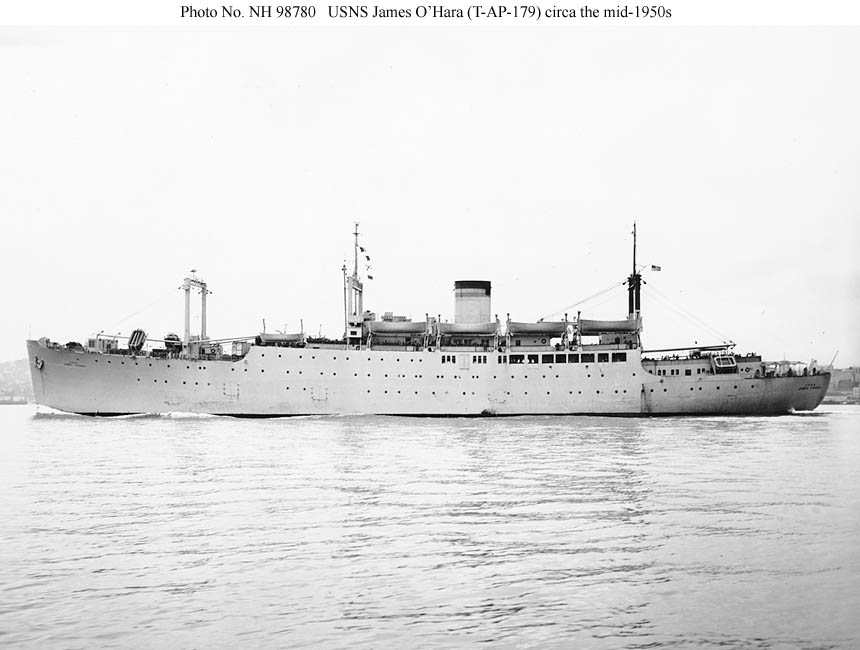
USNS James O'Hara (T-AP-179) Photographed between 1950 and 1956 as a civilian-manned Military Sea Transportation Service ship. Photo No. NH 98780 Source: U.S. Naval History and Heritage Command |
 |