 Return to WWI Auxiliaries.
UNITED STATES NAVY
TEMPORARY AUXILIARY SHIPS
WORLD WAR I
TEMPORARY AUXILIARY SHIPS
WORLD WAR I

Online Library of Selected Images:
-- U.S. NAVY SHIPS --
USS Columbia (AG-9), 1921-1922.
Originally Great Northern (ID # 4569, later AG-9)
In August 1921 the Navy reacquired the Army Transport Great Northern. Built in 1915 as a commercial passenger steamer, she served in the Navy during and immediately after World War I as the troop transport Great Northern. Now she received a new role, as administrative flagship for the U.S. Atlantic Fleet (soon rechristened simply "U.S. Fleet"). Commissioned as USS Great Northern (AG-9), she carried passengers from California to the Caribbean and the East Coast before embarking the Fleet's commander, Admiral Hilary P. Jones, and his staff in mid-October 1921. Renamed Columbia a month later, she accompanied the fleet in U.S. and Cuban waters until late February 1922. After steaming north to Chester, Pennsylvania, she was decommissioned in early March and transferred to the U.S. Shipping Board. The ship subsequently had a long commercial career and during World War II again operated as an Army transport.
USS Columbia's brief service represents an early effort to provide major Naval forces with specialized flagships. This would remove a fleet's large administrative staff from already crowded warships, provide more space for supervisory and planning functions, isolate delicate communications gear from gunfire shock and battle damage risks, and free the combatants for their primary fighting duties. The experiment was apparently about two decades premature. The notion resurfaced, with far more lasting results, in the form of the World War II amphibious force flagship (AGC) and the postwar tactical command ships (CLC and CBC). Under the designations LCC and AGF (the latter rather closer in concept to Columbia's purpose), the U.S. Navy's specialized flagships continue active employment into the Twenty-first century.
This page features, and provides links to, all the views that are available concerning USS Columbia (AG-9).
For other images related to this ship, see:
Click on the small photograph to prompt a larger view of the same image.
|
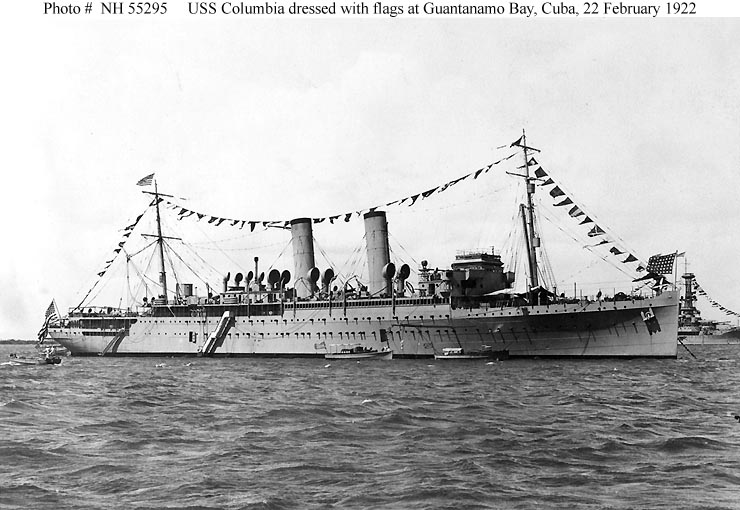
Photo #: NH 55295 USS Columbia (AG-9) At Guantanamo Bay, Cuba, dressed with flags for George Washington's Birthday, 22 February 1922. This ship served as USS Great Northern in 1917-1919. Courtesy of the Naval Historical Foundation -- Collection of Admiral Hilary P. Jones. U.S. Naval Historical Center Photograph. Online Image: 86KB; 740 x 510 pixels |
 |
|
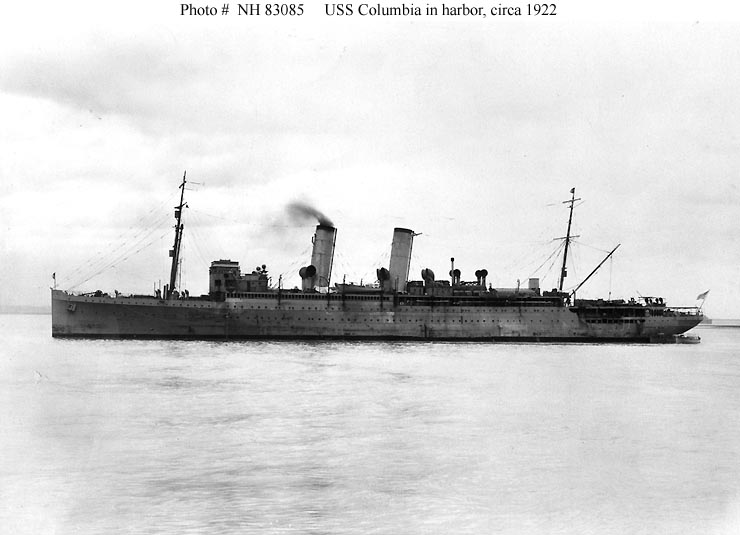
Photo #: NH 83085 USS Columbia (AG-9) In harbor, circa 1922, while serving as administrative flagship for the Commander in Chief, U.S. Fleet, Admiral Hilary P. Jones. Courtesy of the Naval Historical Foundation -- Collection of Admiral Hilary P. Jones. U.S. Naval Historical Center Photograph. Online Image: 50KB; 740 x 535 pixels |
 |
|
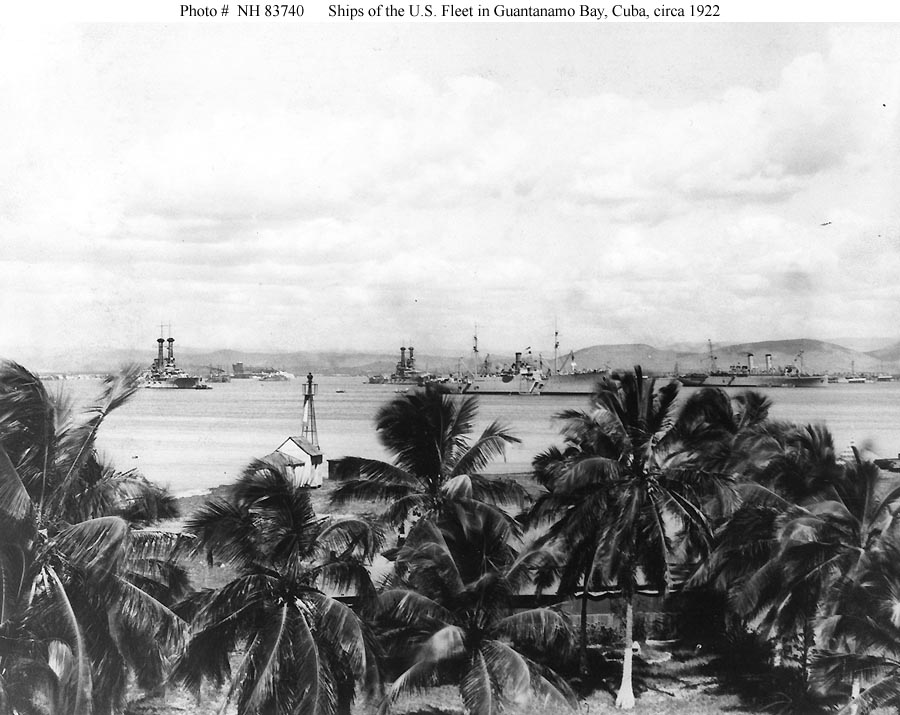
Photo #: NH 83740 Guantanamo Bay, Cuba View of the harbor, with battleships, destroyers and auxiliaries of the U.S. Fleet present, circa 1922. Ship in center is USS Vestal (AR-4). In the right distance is USS Columbia (AG-9), the Fleet's administrative flagship. Courtesy of the Naval Historical Foundation -- Collection of Admiral Hilary P. Jones. U.S. Naval Historical Center Photograph. Online Image: 112KB; 900 x 715 pixels |
 |
|
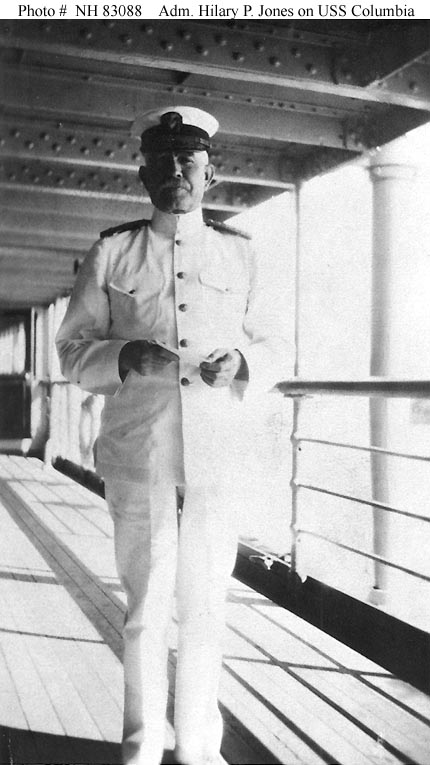
Photo #: NH 83088 Admiral Hilary P. Jones, USN, Commander in Chief, U.S. Fleet On board his administrative flagship, USS Columbia (AG-9), circa 1922. Courtesy of the Naval Historical Foundation -- Collection of Admiral Hilary P. Jones. U.S. Naval Historical Center Photograph. Online Image: 60KB; 430 x 765 pixels |
 |
|
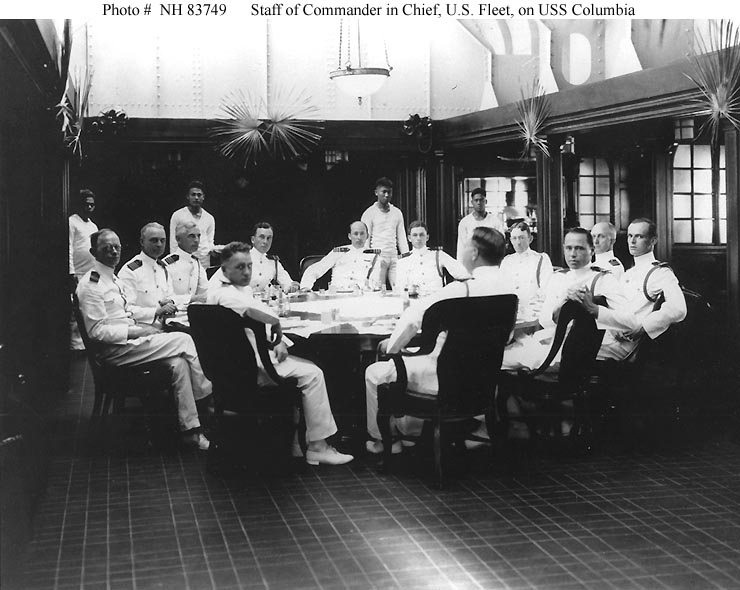
Photo #: NH 83749 U.S. Fleet staff officers In the ward room of the Fleet's administrative flagship, USS Columbia (AG-9), circa 1922. Those present include (in no particular order): Commander Benjamin Dutton, Jr.; Commander Edgar G. Oberlin; Lieutenant Commander William S. Farber; Lieutenant Commander Jules James; Lieutenant Tunis A.M. Craven; Lieutenant Andrew R. Mack; Lieutenant Robert L. Porter, Jr.; Captain Charles E. Riggs (Medical Corps); Captain George Brown, Jr. (Supply Corps); Commander Robert B. Hilliard (Construction Corps); Captain Bower R. Patrick (Chaplain Corps); and Lieutenant Colonel John W. Wadleigh, USMC. Courtesy of the Naval Historical Foundation -- Collection of Admiral Hilary P. Jones. U.S. Naval Historical Center Photograph. Online Image: 77KB; 740 x 590 pixels |
 |
For other images related to this ship, see:
 Return to WWI Auxiliaries.
Page made 30 January 2006