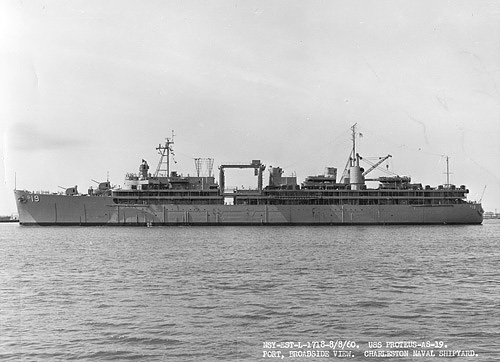
USS Proteus (AS 19).
Click on this photograph for links to larger images of this class.
Class: PROTEUS (AS 19 FBM)
Design: Navy AS 11/SCB 190
Displacement (tons): 14,218 light, 18,822 full
Dimensions (feet): 574' oa, 564' wl x 73' e/wl x 26'
Armament: (1959) 2-5"/38; (1963) 1-5"/38; (1974) none; (1976) 4-20mmS
Accommodations: 84 officers and 1210 enlisted
Speed (kts.): 15.4
Propulsion (HP): 11,520
Machinery: G.M. diesel electric, 2 screws
Construction:
| AS | Name | Ord | Builder | Start | Launch | Comm |
| 19 | PROTEUS | 7 Jan 1959 | NSY Charleston SC | 19 Jan 1959 | -- | 8 Jul 1960 |
Disposition:
| AS | Name | T | Decomm | Strike | Disposal | Fate | MA Sale |
| 19 | PROTEUS | 1 Jul 1999 | 13 Mar 2001 | ca Jun 2007 | Navy sale | -- |
Class Notes:
The history of this ship before her FBM conversion is given with the rest of the FULTON (AS 11) class in the World War II section of this site.
In the summer of 1956 the Navy's efforts to develop a strategic nuclear strike weapon converged on the small solid-fueled submarine-launched ballistic missile that soon became the POLARIS Fleet Ballistic Missile (FBM). In October 1956 the POLARIS program received the highest national priority, equal to that of the Air Force's THOR. By May 1957 the Navy had decided that the primary tactical delivery ship wold be a submarine and that the gas ejection principle, which employed a single vertical tube for each missile, would be employed for launching. The program acquired even more urgency in the fall of 1957 when the Soviets launched the first two Sputniks. The program involved not only missiles and submarines but support for them, and on 3 December 1957 CNO as chairman of the SCB asked BUSHIPS for feasibility and cost studies for tenders for FBM submarines, both conversions from AS types in the reserve fleet and new construction.
Two days later BUSHIPS reported the results of a study of a conversion of an AS 23 class C3 hull, of which four (AS 23-26) were in the reserve fleet, along with two diesel-powered C3 hulls (AS 13-14). A 492-foot C3 could be converted with storage for eight POLARIS missiles but would have only austere tender support capabilities, while the equivalent new construction tender with eight missiles would be a 543-foot ship meeting all requirements but costing almost five times as much and taking over twice as long to build. A working level meeting of the Ship Characteristics Board on 13 December 1957 generated additional desirable characteristics not covered in the BUSHIPS studies, and by 23 December the number of missiles in the C3 conversion had been increased to twelve by moving them closer together, and there were also to be tubes for two dummies and an empty one for transfer handling for a total of fifteen. On 23 January 1958 the Ship Characteristics Board distributed a staff proposal for a submarine tender conversion for FBM submarine support, SCB Project No. 190, that provided for the conversion of submarine tenders of the "CLYTIE (AS 26) class." This converted C3 was to be able to support six submarines with a maximum of three receiving full alongside services and was to have "at least" fifteen vertical missile stowage tubes with twelve replacement missiles. Two dummy missiles could be stowed on the weather deck. The ship was to have facilities for replacing reactor fuel elements with spares stored on board the tender, a requirement of Rear Adm. Rickover. Studies began immediately on conversions of the AS-23 (AS 26) and AS-11 classes as well as a new construction tender that became AS-31 and a separate "missile support ship," a missile transport converted from the AK 156 (C1-M-AV1) type that would allow reducing missile stowage requirements for the tenders. (This idea reappeared in the FBM conversions of AK 259-260 and AK 279-282.)
By late February 1958 it had been decided that the revised characteristics precluded the conversion of the AS-23 type, which lacked enough ship volume, while the AS 11 conversion could meet the proposed characteristics if carying twelve missiles. It could however not meet a requirement of Rear Adm. Raborn of BUORD Special Projects to be able to offload a full load of 16 missiles from a submarine. The chief of BUSHIPS also deleted Rickover's requirement for replacing reactor fuel elements, arguing that submarines should return to the U.S. for reactor work. On 10 March 1958 the Ship Characteristics Board distributed preliminary characteristics for a submarine tender conversion for FBM submarine support, SCB Project No. 190. The new characteristics provided for the conversion of submarine tenders of the FULTON (AS 11) class instead of the AS 23 class. Like the January staff proposal they called for retention of the existing hull and propulsion plant. They added support of "the maximum practicable number of attack submarines" to the six FBM submarines in the January characteristics, replaced "facilities for replacing reactor fuel elements" with "facilities for limited repair of nuclear power plants," and took advantage of the larger capacity of the AS 11 class to increase stowage of some items, notably torpedoes. Otherwise the new characteristics largely duplicated those for the AS 23 conversion. They retained the requirement for fifteen missile tubes, although two separate AS 11 conversion studies based on the original 530-foot hull, one austere and one full, had been done with stowage for 16 missiles. The March characteristics also stated that handling equipment for moving assembled missiles with a lifting capacity of 20 tons was required, although the full conversion study substituted a new 30-ton crane for the existing capability. Of the AS 11 class, PROTEUS (AS 19) had been placed in reserve in 1947 after relatively short service and in 1958 was "In Service in Reserve" in the New London Group of the Atlantic Reserve Fleet. She was thus operationally available although she would incur extra expenses for reactivation work. Design work for her conversion proceeded in parallel with that for the new construction HUNLEY (AS-31).
An SCB meeting of 11 June 1958 produced two questions for BUSHIPS, the first asking if conversion costs could be reduced by reducing the FBM missile stowage requirement from twenty to six (apparently Adm. Raborn's sixteen were now in the draft characteristics with four spares) and the second asking for more information on the facilities for limited repair of nuclear power plants in the March preliminary characteristics. On 2 July 1958 BUSHIPS reported that it had made three new studies of the SCB 190 conversion, one with no increase in length and stowage for 6 missiles, one with a 30' increase in length and 6 missiles, and one with a 44' increase in length and 20 missiles. Habitability and shop and storage space were inadequate in the unlengthened ship, essentially making it unsatisfactory. They were adequate in both lengthened ones, and in either case the lengthening also provided space for full nuclear support with stowage for 21 reactor fuel modules instead of limited support with only four. The cost difference between the 30' and 44' variants was only $0.3 million, causing the Bureau to recommend the 44' lengthening over the 30' one. Approved characteristics for the AS-19 submarine tender conversion, SCB Project No. 190, were promulgated on 18 August 1958 and updated on 17 July 1959 with a final change on 7 May 1962. The ship was now to support nine SSBNs or the maximum practicable number of other type submarines with complete services to three of them alongside. The ship's length was now 574' instead of 530'. Vertical stowage for at least 20 missiles in their tubes was to be provided. Missile handling equipment with a lifting capacity of about 25 tons was required. Repair facilities were to include facilities for replacement of reactor fuel elements and control rods. Another substantial increase was made in torpedo stowage space. During the subsequent design process, new deck houses were added and some storeroom spaces were converted to living spaces to alleviate the crowded conditions of existing living quarters. On 29 July 1958 a second Project 190 AS conversion was dropped from the proposed FY 1960 program as it appeared that the one AS conversion in the FY 1959 program and the one new construction Project 194 AS in FY 1960 would be adequate.
Based on a required deployment date of 1 October 1960 a schedule was developed requiring allocation of the conversion to a shipyard by 1 September 1958, signature of contract plans and specifications on 3 November 1958, and start of conversion on 1 January 1959. As of 9 October 1958 the conversion of PROTEUS under FY 1959 had not yet received formal approval and the first date had already passed, although work on the plans and specifications was on schedule. On 22 October 1958 and with the contract plans and specifications now due for completion on 3 November 1958, BUSHIPS assigned to the NSY Charleston (S.C.) design agent responsibilities for the preparation of the conversion working plans. On 6 January 1959 BUORD advised BUSHIPS that the ship would also have to support the Polaris Model A-2 missile, then in development for the SSBN 608 class, and that the tender's FBM cranes would have to handle a three foot growth in the length of the missile container. This was in addition to an extra two feet requested for the A-1 model of the SSBN 598 class back in August 1958. Crane lifting capacity and outreach were not affected. On 7 January 1959, with the conversion now confirmed in the FY 1959 program, BUSHIPS assigned the conversion of the ship to NSY Charleston. The ship started conversion on 19 January 1959 and was scheduled for completion on 16 June 1960 (the actual date was 24 July 1960) and reporting for duty on 1 October 1960 after fitting out and trials. On 6 February 1959 BUSHIPS reported to CNO (as chairman of the SCB) why the cost estimate for the conversion had risen from $23 million in July 1958 to $33 million. The characteristics were reviewed by the SCB on 5 May 1959, and the $33 million cost estimate was accepted with only minor changes to the characteristics. The only technical change of interest in the characteristics as updated on 17 July 1959 was an increase in the lifting capacity of the missile handling equipment from 25 tons to nearly 30 tons. On 26 January 1960 the requirement to service three submarines alongside was expanded to providing complete services including electrical power to three SSBNs and simultaneously furnishing electrical power only to an additional three SSNs.
PROTEUS entered NSY Charleston on 15 January 1959 for conversion and was placed in drydock. On 8 and 9 June the hull was cut in half and the after half was floated and moved 44 feet aft in the dock. The 44-foot plug with its 20 missile storage tubes was constructed in place. Work was completed in June 1960, the ship left for initial sea trials on 6 July 1960, and she recommissioned on 8 July 1960. After initiating tender support of SSBNs at Holy Loch, Scotland, in 1961 and Rota, Spain, in 1964, she moved later in 1964 to Guam where she spent much of the rest of her career.
By the end of the 1980s Polaris was gone and in 1992 the US Navy’s last Poseidon patrol was made, and with it any lingering need to support SSBNs abroad ended. On 24 March 1992 PROTEUS was ordered to be stricken effective the date of her decommissioning. She was inactivated at Apra Harbor, Guam, on 11 July 1992 and then proceeded to Bremerton where she was decommissioned and stricken on 30 September 1992. She was to have been turned over to MARAD for storage but, with USS NIMITZ (CVN 68) due for her first Extended Dry-docking Selected Restricted Availability (EDSRA) at NSY Puget Sound (Bremerton), she was instead converted from mid-1993 to early 1994 by George G. Sharp, Inc. into an accommodations barge. She lost her stacks, cranes, and other topside fittings in an effort to establish a heating and air conditioning boundary shipwide to lower the operating costs of using such a large hull for this new mission. NIMITZ entered drydock at NSY Puget Sound on 29 January 1994, and effective 1 February 1994 ex-PROTEUS was reinstated on the Naval Vessel Register as IX 518 (no name) and designated as a Berthing and Messing Barge to serve the carrier's crew. NIMITZ left the yard for initial sea trials on 19 January 1995 and was followed at Bremerton by USS ABRAHAM LINCOLN (CVN 72) for her first EDSRA from 17 November 1995 to 30 November 1996 and by USS CARL VINSON (CVN 70) for an overhaul from 12 January to 12 September 1997. IX 518 was placed out of service on 1 July 1999, moved into MARAD storage at Suisun Bay on 24 September 1999, and stricken definitively on 13 March 2001.
Ship Notes:
| AS | Name | MA | Notes |
| 31 | PROTEUS | FY 1959. Originally comm. 31 Jan 1944. In service in reserve at New London 26 Sep 1947 to January 1959. Stk. 30 Sep 1992, converted to a berthing and messing barge and reinstated as IX 518 1 Feb 1994. Out of service 1 Jul 1999, to NDRF Suisun Bay 24 Sep 1999. Withdrawn from NDRF by Navy 7 Jun 2007 for scrapping at Brownsville, Texas, arrived 1 Jul 2007, BU completed 3 Jun 2008. |
Page Notes:
Compiled: 15 May 2024
© Stephen S. Roberts, 2024
Special sources: NARA: RG 19 Item S-13 Entry P 62 Boxes 9-10 and 73 (SCB 190); wwiiafterwwii.wordpress.com/2022/07/29/jumboized-wwii-warships/; www.tendertale.com/tenders/119/119.html