Comet (T-LSV 7) Class: Photographs
| These photographs were selected to show the original configuration of this class and major subsequent modifications. For more views see the former NHHC (now Hyperwar) Online Library of Selected Images and the NavSource Photo Archive. |
Click on the small photograph to prompt a larger view of the same image.
|
Navy design for T-AK 269 The Bureau of Ships design for the ship (PD 2698) after changes requested by MSTS were incorporated in it in early June 1954 and before it was set aside in late June 1954 in favor of a very different design by the design agent for the ship, George G. Sharp. Photo No. None Source: U.S. Naval History and Heritage Command |
 |
|
USNS Comet (T-AK 269) A diagram showing the internal structure of the ship as built, including the decks and the ramps for moving vehicles between them. The side ports are the heavy black squares, and the stern ramp is also shown. The ship also had conventional breakbulk cargo booms and hatches. Photo No. None Source: U.S. Naval History and Heritage Command (MSC) |
 |
|
USNS Comet (T-AK 269) The MSTS caption describes her as one of MSTS's pioneering roll on, roll off ships and explains that cargoes of wheeled or tracked vehicles were diven onto the ship through either side or stern hatches and driven off at their destination, resulting in a large time saving over the conventional lift on/lift off method. She was delivered as T-AK 269 in January 1958 and reclassified T-LSV 7 effective June 1963 and T-AKR 7 effective January 1969. Photo No. None Source: U.S. Naval History and Heritage Command (MSC) |
 |
|
USNS Comet (T-LSV 7) At Naha Port, Naha, Okinawa, on 19 June 1965. Photo No. USN 1113421 Source: Shipscribe |
 |
|
USNS Comet (T-LSV 7) Handling Army vehicles in a port, probably overseas, before 1973. One side port and the stern port are open with vehicle ramps extended onto the pier. Photo No. USN 1113421 Source: Shipscribe |
 |
|
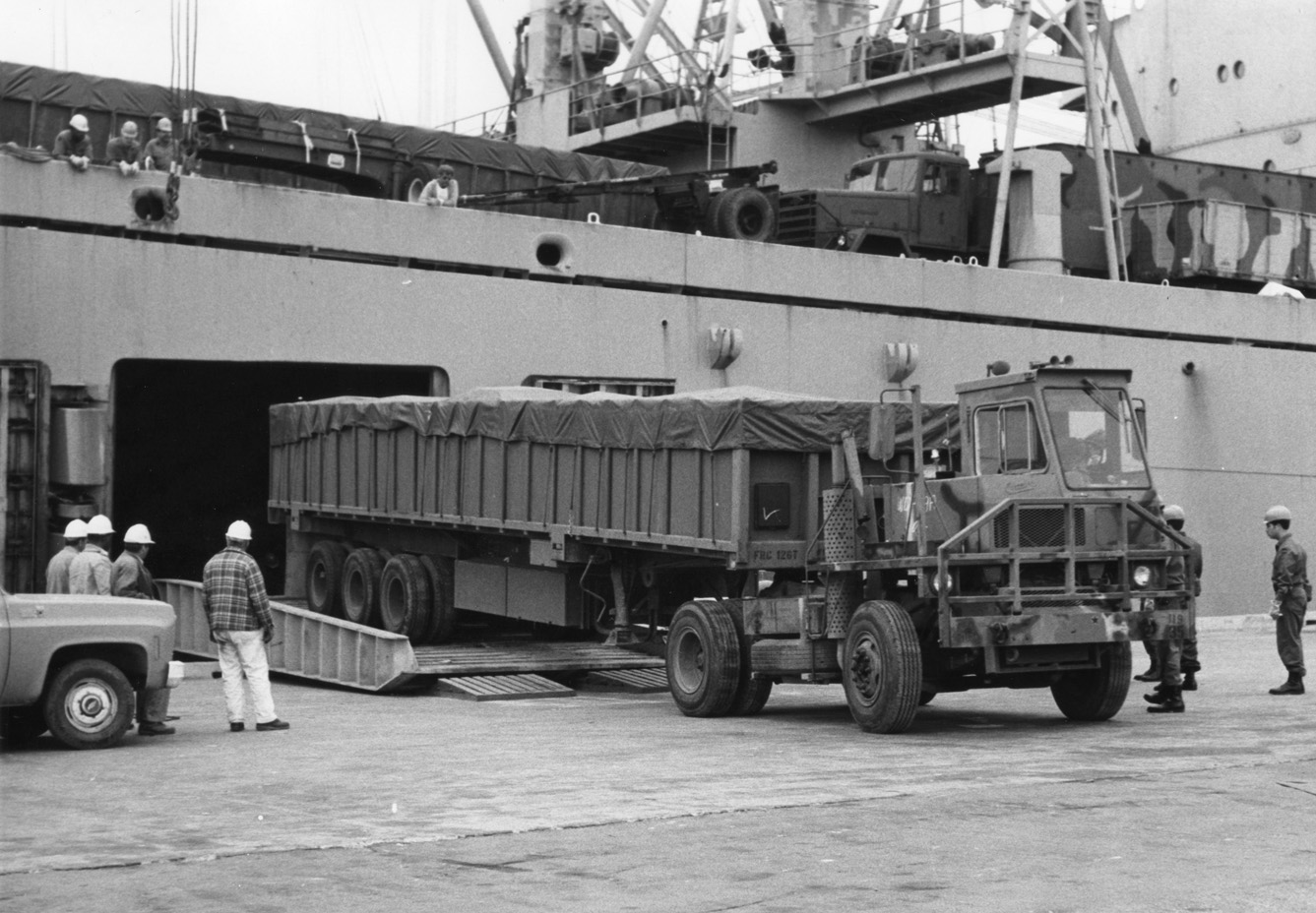
USNS Comet (T-LSV 7) A long Army truck using the forward port on Comet's port side. The port sill is practically even with the pier making the ramp nearly flat. Other long trucks are loaded on deck. Photo No. None Source: U.S. Naval History and Heritage Command (MSC) |
 |
|
USNS Comet (T-LSV 7) A civilian-type Fruehauf truck trailer with an Army prime mover using the after port on Comet's starboard side. The wood shoring and ramp extension had to be improvised to get the trailer landing wheels to clear the steep incline of the ramp. A high tide or the loading of the ship may have contributed to the problem. Photo No. None Source: U.S. Naval History and Heritage Command (MSC) |
 |
|
USNS Comet (T-LSV 7) An Army truck with a trailer exiting Comet's stern ramp. Photo No. None Source: U.S. Naval History and Heritage Command (MSC) |
 |
|
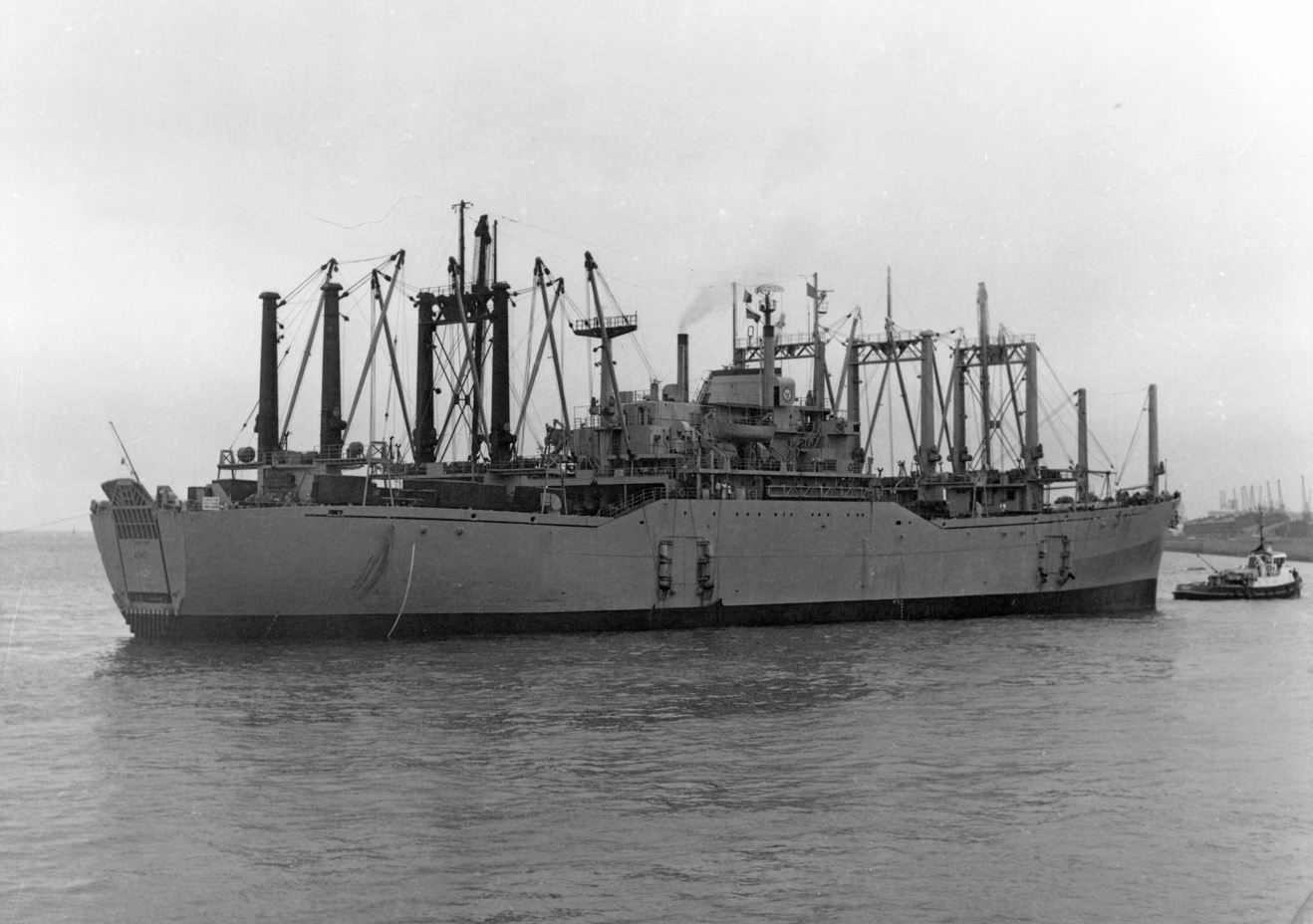
USNS Comet (T-AKR 7) Note the engine room exhaust rising from the pipe to the left of the dummy smokestack. The new MSC insignia was added in about 1973 on panels outboard of both exhaust pipes because there was not room for it on the pipes. Photo No. None Source: U.S. Naval History and Heritage Command (MSC) |
 |
|
USNS Comet (T-AKR 7) Seen from a pier with a side vehicle port in use. The MSC insignia, which was used between about 1973 and 1985, is visible on a panel outboard of the port exhaust pipe. Photo No. None Source: U.S. Naval History and Heritage Command (MSC) |
 |
|
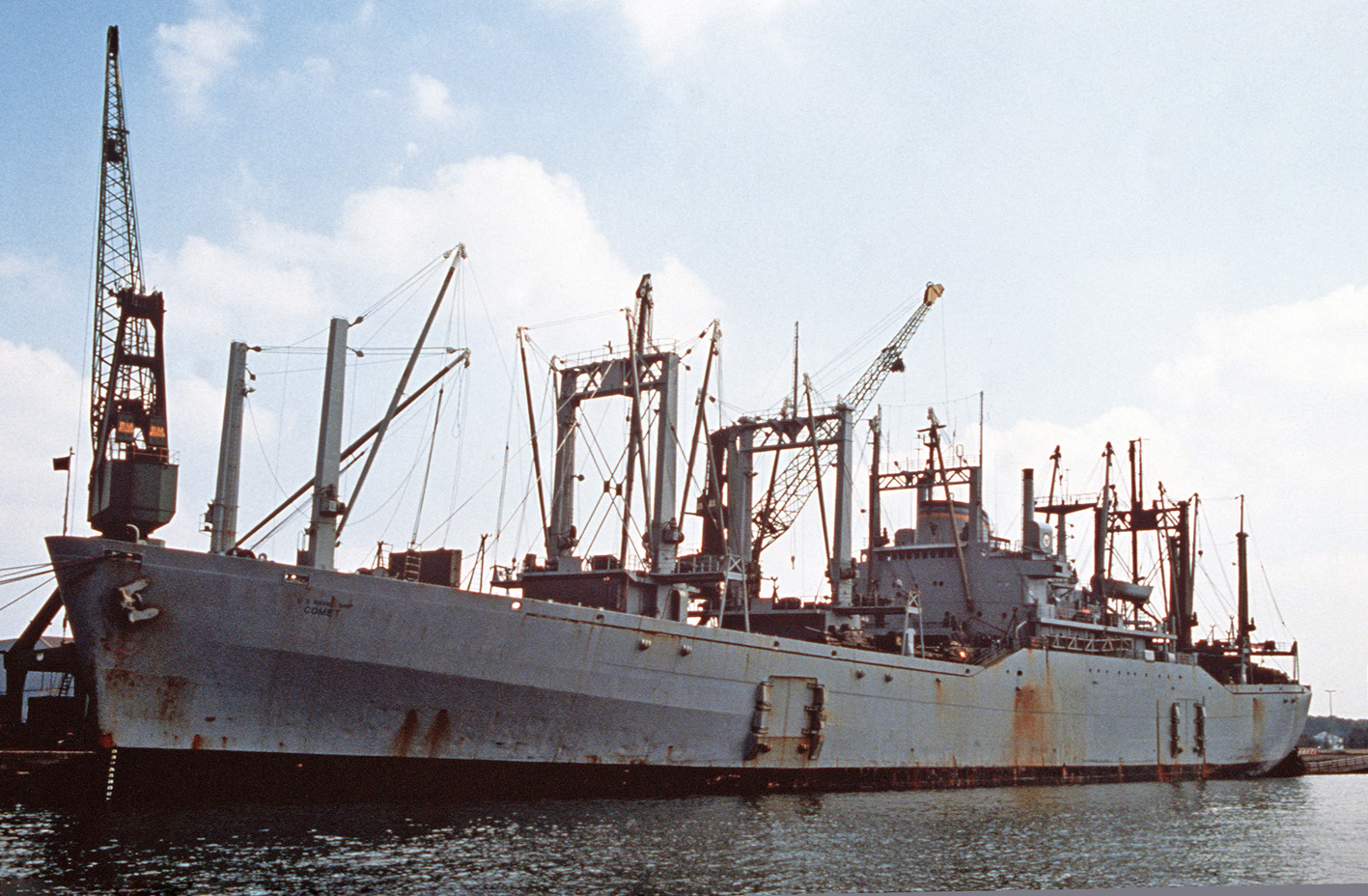
USNS Comet (T-AKR 7) At a pier in Ghent, Belgium, on 24 August 1990 during Operation Reforger. She still displays the MSC insignia, which by then had been deleted from the stacks of most MSC ships. Photo No. DN-ST-90-11479 Source: U.S. National Archives (RG-330) |
 |