From Clockmakers to a China Missionary

From Clockmakers to a China Missionary:
Writings of James Hudson Roberts (1851-1945)
|
The missionary couple returned to China in 1901 but returned to Hartford in 1906 to help support aging relatives. In 1917 sickness intervened, leading to the death of Grace Lilla Roberts in 1920. During this time JHR worked on a family genealogy which he compiled in 1921 under the title "Roberts and Related Families." The early Roberts family included some important early American clockmakers, notably Gideon Roberts (1749-1813). JHR also remarried in 1921, this time remaining in Connecticut. However he continued to treasure both his late wife and their experiences in China, and he completed in 1927 an account of both, "A Heroine of China Missions: Grace Lilla (Howe) Roberts," which contains many stories of missionary life in China in the late 19th century.
"Thrilling Tales from Far Cathay" (written in 1931) contains on pages 1-26 the story told by Captain Lew Buah, commander of the Chinese warship FU PO in the battle with the French at Foochow in August 1884, to JHR during a visit to the Roberts mission in Kalgan in January 1886. (This visit is also mentioned in "A Heroine of China Missions," pages 122-123.) JHR did not vouch for the truth of the story, but it does correspond well to historical events. The first episode occurs during 1874 when Japan sent an expedition to occupy Formosa, withdrawing later in return for an indemnity. Two Chinese naval vessels were lost in that year in storms, AN LAN and TA YA, of which AN LAN appears to have been the smaller. AN LAN probably was Lew's command, the loss of the other ship also being referred to in the story. Captain Lew's next command, "Chee An," is easily recognizable as CHI AN, while his command at Foochow, "Hoppo", can only be FU PO. As to Captain Lew's claim that he saved his ship, other sources are contradictory - a contemporary photograph caption says that FU PO was the only ship afloat after the battle while another source says she broke her back running up the river. At any rate, the punishment of overly competent officials was typical of the last years of the Chinese Empire, and is not in itself reason to doubt Captain Lew's word. This story was published by Lt. Stephen S. Roberts, USN, in Warship International, No. 1 (March) 1974, pages 51-57.
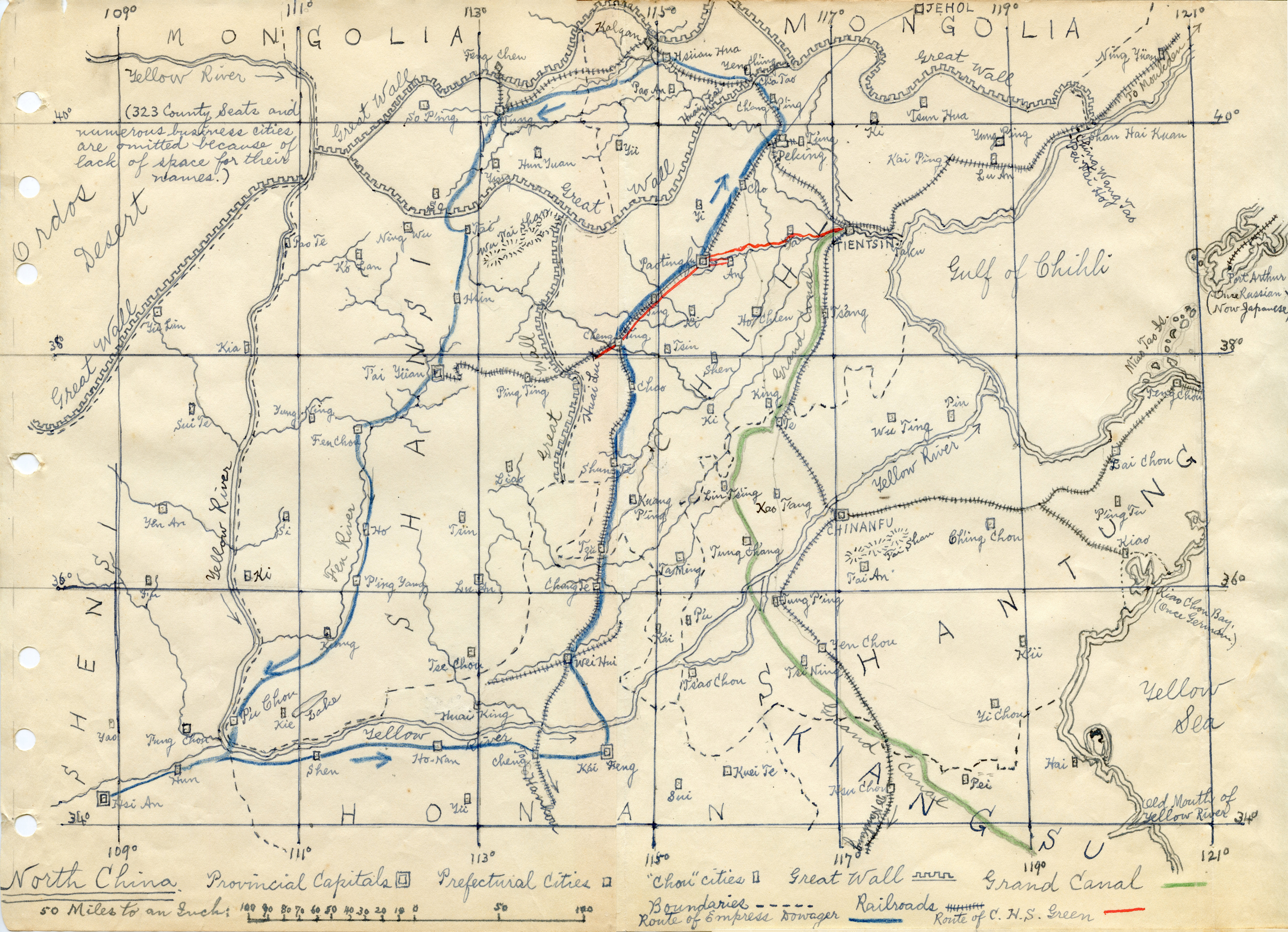
Otherwise "Thrilling Tales" focuses on the life-story of the Empress Dowager of China including the events up to and during the Boxer Rebellion of 1900. A small bit of the text on page 74 is obscured by a newspaper clipping pasted over it. The obscured text reads: "On the first night after leaving Peking, they slept, like travelers of the very lowest class, on the raised brick platform of the inn, where not even rice was obtainable for the evening meal, so that they were compelled to eat common porridge made of millet." The illustrations listed after the table of contents were not filed with the manuscript. "Our Ancestors, What Were They Like?" (1934), the last of the writings presented here, was based on the genealogical research that he began in 1906. James Hudson Roberts died on 15 May 1945, shortly before the birth of his second great-grandson, James Newton Roberts. (Primary source for this introduction: pages H-L at the beginning of "Our Ancestors, What Were They Like?".)
Go to Shipscribe Home Page
This entire site, including all its pages, is copyright © Stephen S. Roberts 2001-2026 or later as indicated.