EFC Design 1006 (Daugherty type): Notes & Illustrations
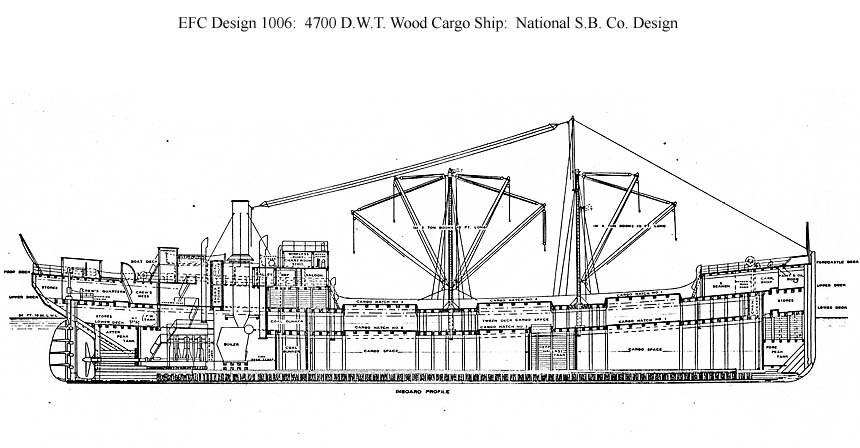
Click here for a larger and more complete copy of this plan: Sheet 1.
Click on the photographs below to prompt larger views of the same images.
|
Notes: The Daugherty type (EFC Design 1006) originated in a contract for twenty 5000-dwt wood cargo ships awarded by the British Cunard Line to the National Ship Building Co. of Orange, Texas, whose president and chief designer A. A. Daugherty prepared the plans and moved from New York to Texas when he got the contract. The first two Cunard ships, War Mystery and War Marvel, were completed in February and January 1918 when they were claimed to be the largest wooden steamships ever built. In the meantime, soon after the U.S. entered the war the rest of the British order was replaced on 11 July 1917 with a 12-ship order from the EFC (its hulls 234-245). Daugherty's original design was revised to meet the requirements of classification societies and became the 4700-dwt EFC Design 1006. A distinctive feature of both Daugherty type designs besides their capacity was the position of their machinery well aft. Despite ambitions to order 100 more Daugherty ships on the Gulf and Atlantic coasts during 1918 only three more orders were placed. One dated 3 May 1918 was with the Union Bridge and Construction Co. of Morgan City, La., for 6 ships (1568-1573) to Design 1051 (the "Gulf Coast" type) with tonnage and dimensions matching those of Design 1006, another dated 3 May 1918 was with National S.B. for 16 more ships (EFC hulls 2529-2544) probably of Design 1006, and one dated 13 August 1918 was with Dierks-Blodgett S.B. of Pascagoula, Miss., for 6 ships (2443-2448) probably also of Design 1006 that were to follow six Design 1001 ships then building there. Later the designs for these three contracts were enlarged to 5000 dwt, the National and Dierks-Blodgett ships becoming Design 1056, but all of these 28 additional ships were ultimately cancelled. At National Ship Building, however, one additional Daugherty hull was completed privately as the diesel tanker J. F. Penrose, two followed as the steam tankers P. J. Reilly and A. A. Daugherty, and a fourth was completed as the sailing tank barge W. A. Ebsen. All four were named for officers of the Texas firm. Specifications: Design 1006 (Daugherty). Wood hull. Deadweight tons: 4700 designed, 4929 actual. Dimensions: 315.0' oa, 300.0' pp x 49.9' ext, 48.0' mld x 28.5' depth mld, 24' draft load. Propulsion: 1 screw, 1 triple expansion engine, 2 Babcock & Wilcox water tube boilers, 1450 IHP, 10 knots. Configuration: 2 decks, 2 holds, 3 hatches. |
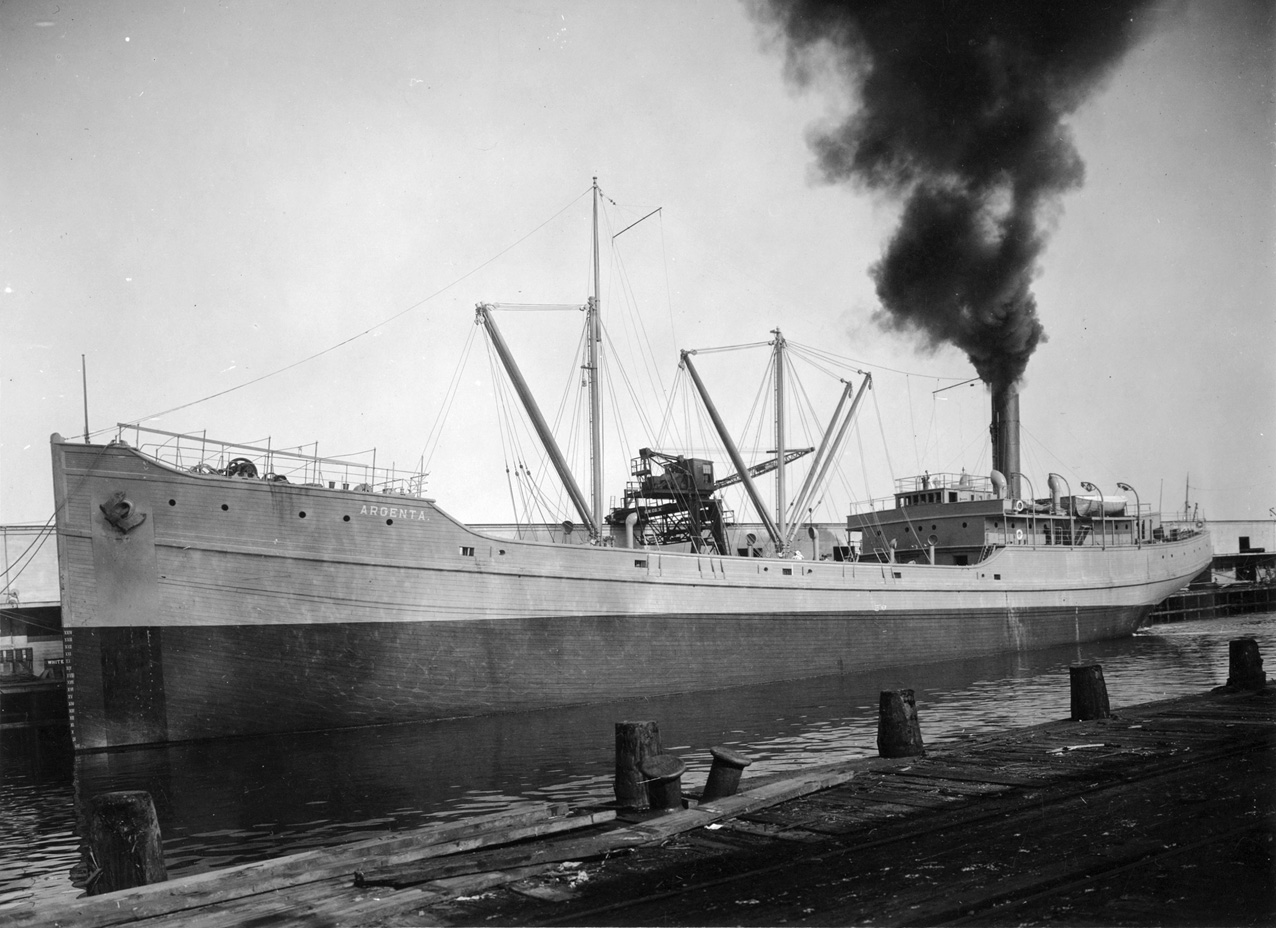
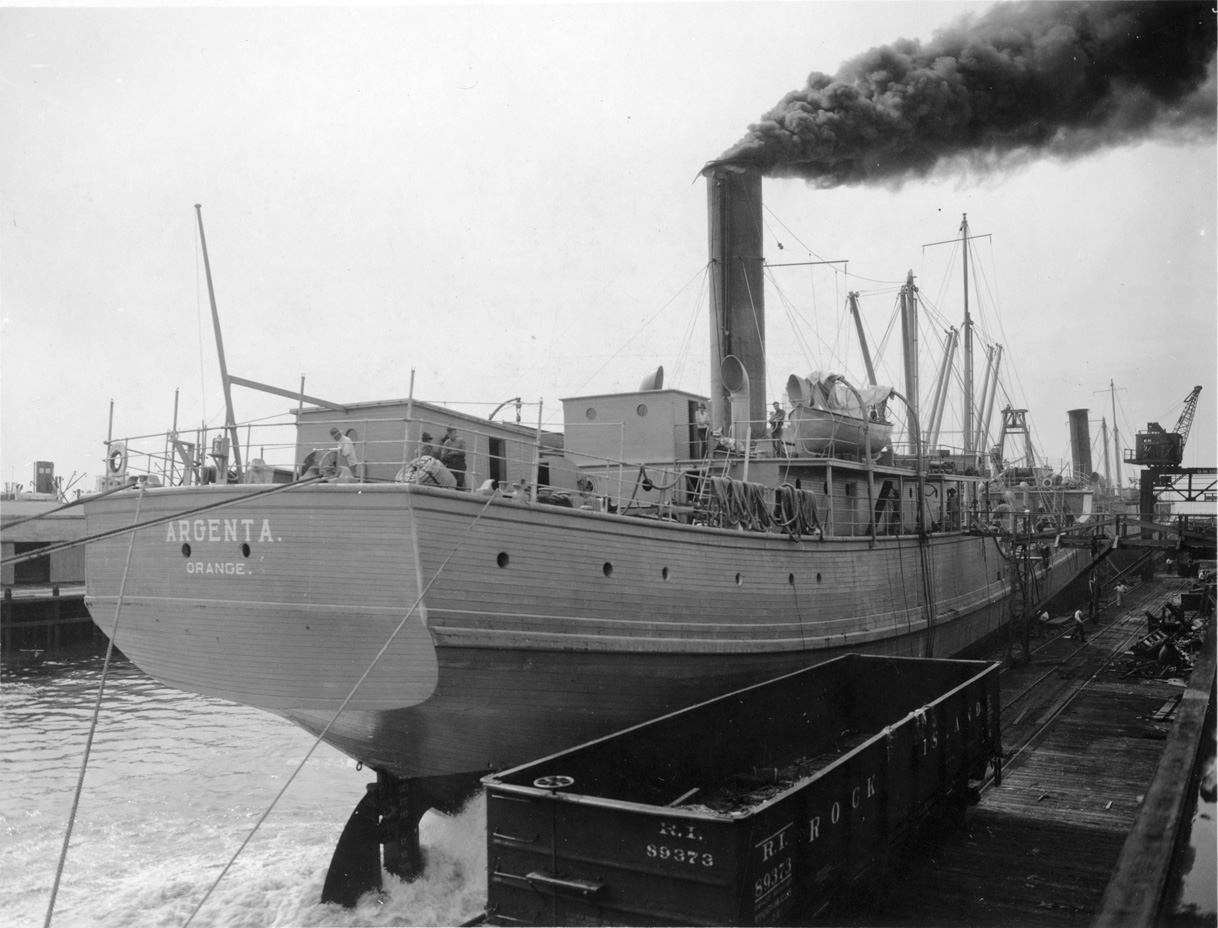
| S.S. Argenta (Design 1006, EFC Hull 245). This Daugherty-type ship is shown around the time of her completion by the National S.B. Co., Orange, Texas on 30 July 1919. She is probably testing her machinery while moored to the pier. (NARA: RG-32-M box 2) (Click photo to enlarge) |
|
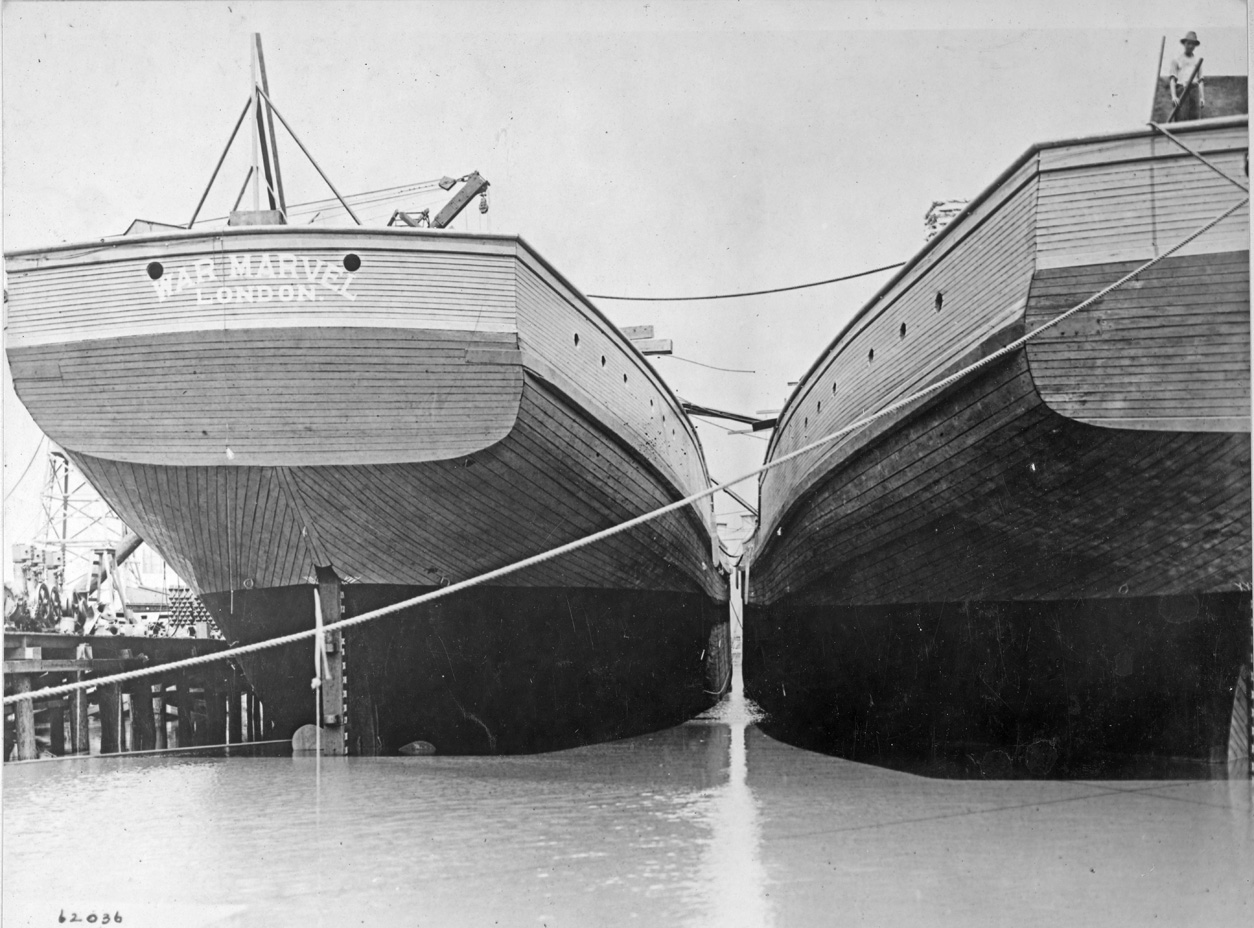
S.S. War Marvel (Design 1006 precursor) Shown fitting out afloat with her sister War Mystery alongside in a photo by the Western Newspaper Union that was received on 10 June 1918. They were built under a British order nominally from the Cunard Line and were completed respectively in January and February 1918. Photo No. 165-WW-504A-039 Source: U.S. National Archives, RG-165-WW |
 |
|
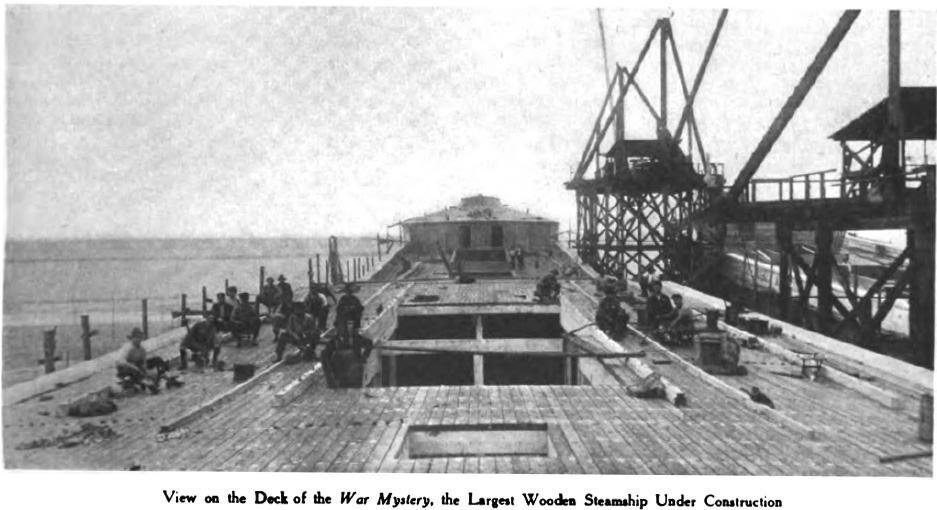
S.S. War Mystery (Design 1006 precursor) A deck view of the ship looking forward in the early stages of fitting out. The opening in the poop deck in the foreground is for the engine and boilers. The main deckhouse was later built here. Between the long poop and the short forecastle are three cargo hatches, the forward one (visible) serving the forward hold and the other two (part of one visible) serving the after hold. Photo No. None Source: International Marine Engineering, April 1918, page 217 |
 |
|
S.S. Argenta (Design 1006, EFC Hull 245) This ship, the last of the EFC's July 1917 order for 12 Design 1006 ships, was completed on 30 July 1919 and delivered on 1 August 1919. Here she is conducting dock trials (operating the propulsion plant while tied up to the pier). Photo No. None Source: U.S. National Archives, RG-32-M box 2 |
 |
|
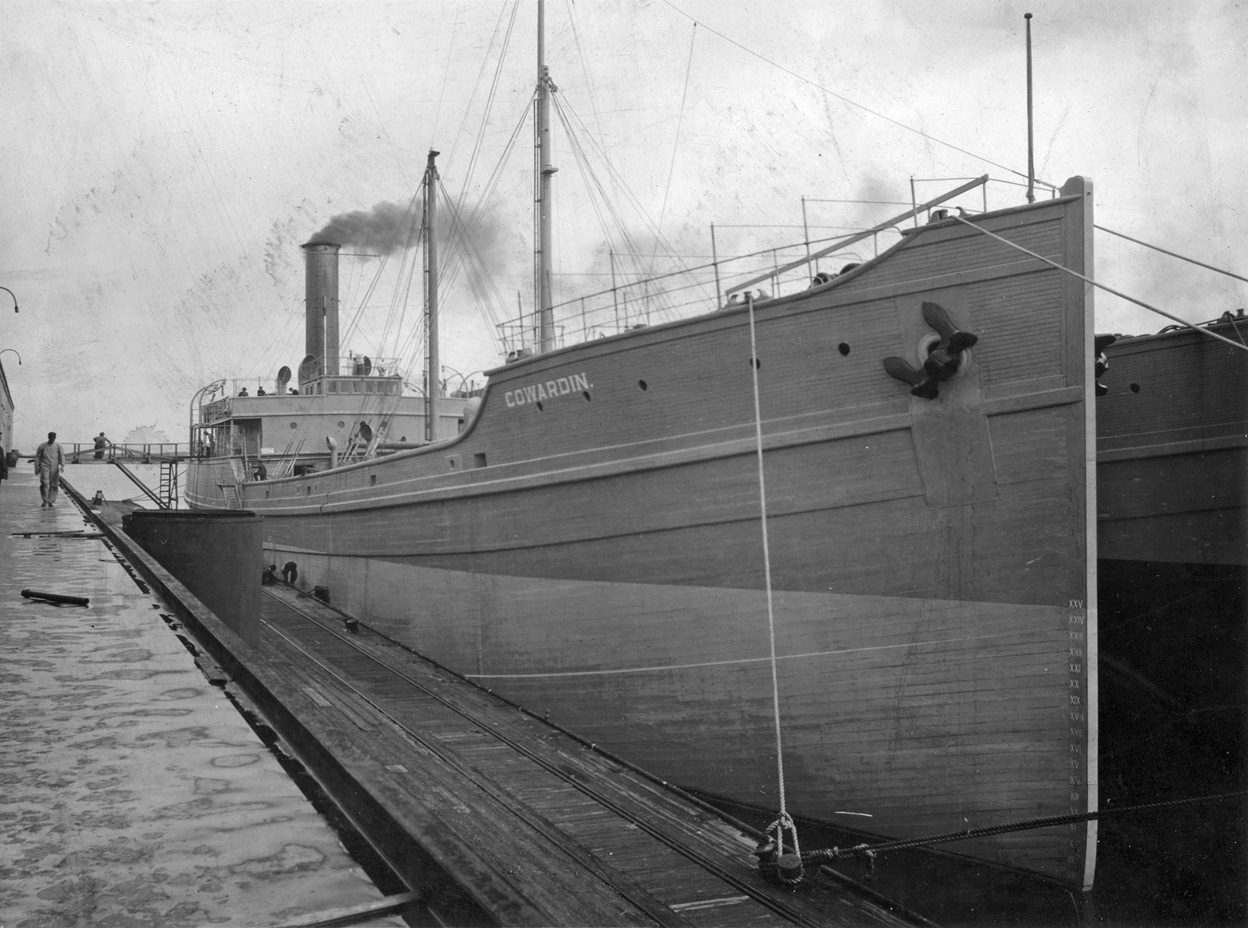
S.S. Cowardin (Design 1006, Hull 238) This, the fifth ship of the July 1917 EFC order, was one of six ships laid down on 20 September 1917 and was delivered to the EFC on 4 April 1919. All but the first two of the twelve ships in this order were sold to the Nacirema Steamship Corp. in April 1919 and delivered between May and August 1919. Nacrirema also got five Design 1011 composite ships in the April sale and more later. The company fell victim to the postwar shipping slump and the last five of its ships were repossessed by the EFC in July 1921. Photo No. None Source: U.S. National Archives, RG-32-M box 2 |
 |
|
S.S. Natenna (Design 1006, Hull 243) This, the tenth ship of the July 1917 EFC order, was laid down on 1 July 1918, and delivered to the EFC and simultaneously to the Nacirema Steamship Corp. on 16 July 1919. She was wrecked in a gale in 1920. Argenta is fitting out behind her. Photo No. None Source: U.S. National Archives, RG-32-M box 2 |
 |
|
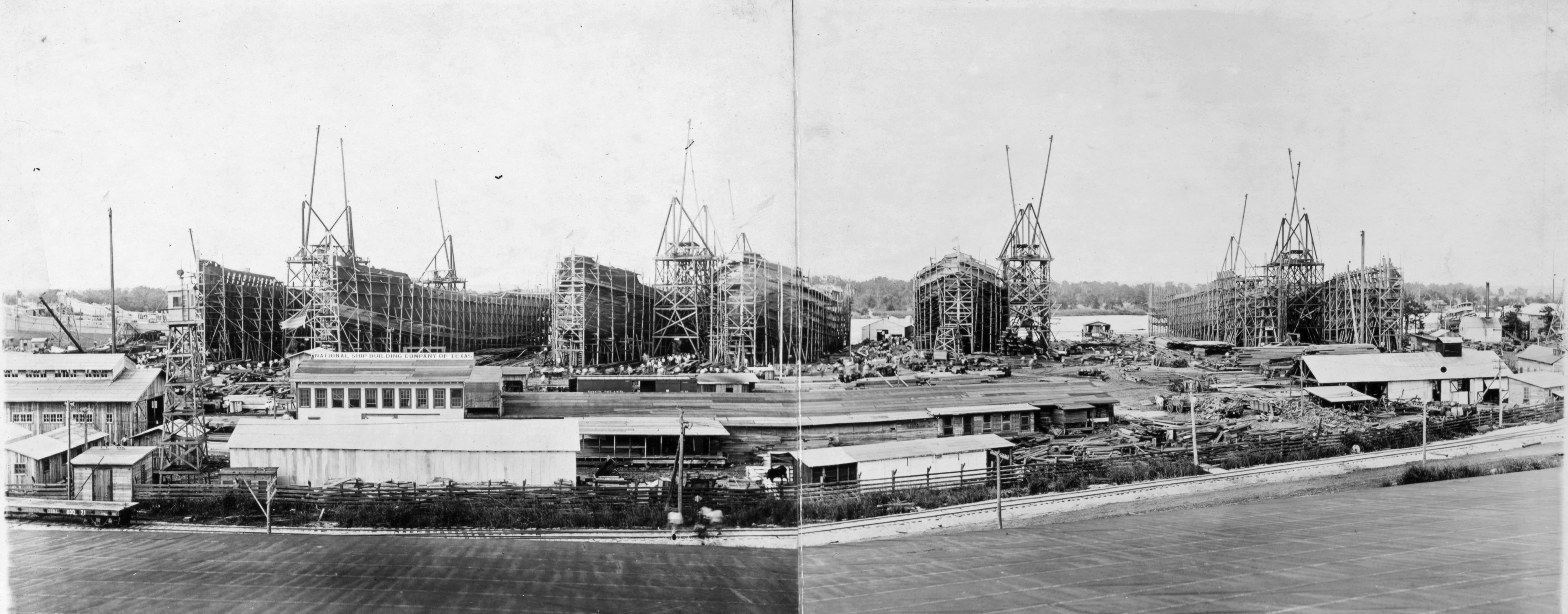
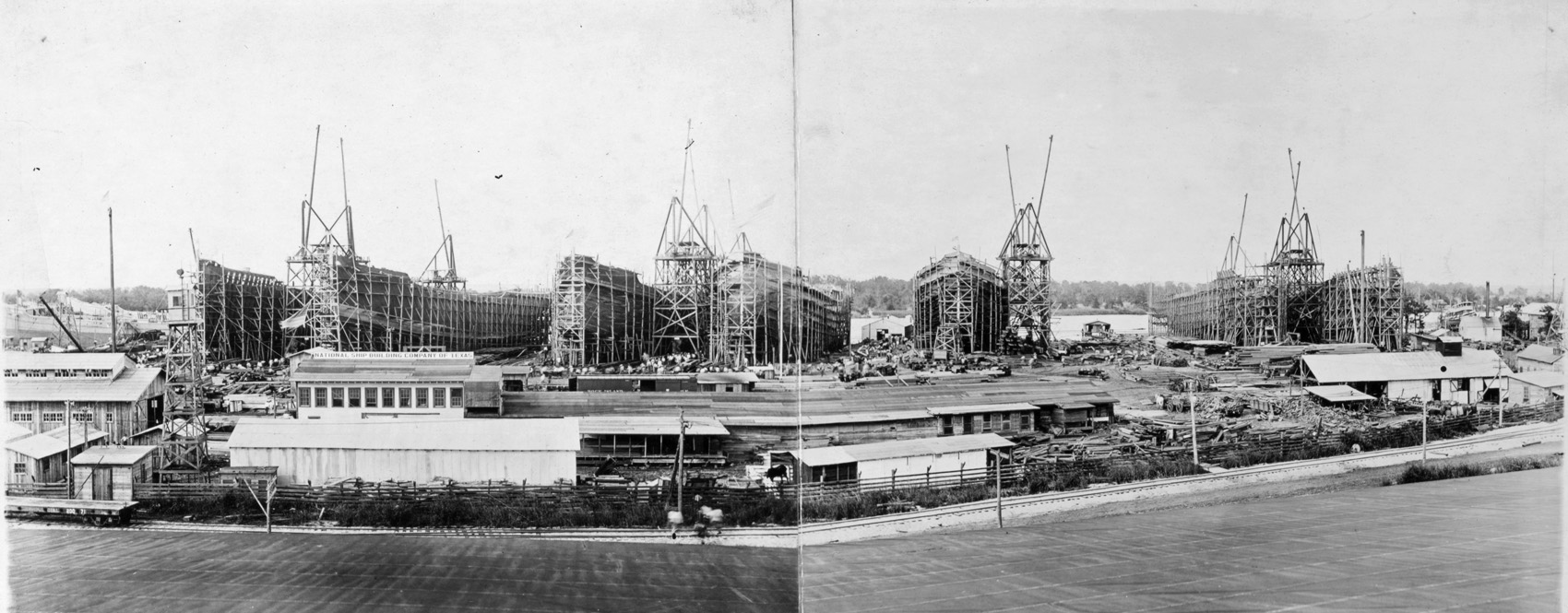
National Ship Building Company of Texas A panoramic view of the yard received by the EFC District Supervisor, Alexander Matland, probably on 14 August 1918. There are two ships fitting out afloat at far left, five ships well along on the ways plus a probable vacant way in the center, and two ships taking shape on the right. The photo may have been taken after Boreta, the second ship in the July 1917 EFC order, was launched on 26 June 1918 and before Natenna, the tenth ship, was laid down on 1 July 1918. Photo No. 165-WW-504A-72 Source: U.S. National Archives, RG-165-WW |
 original size JPG |