EFC Design 1065 (Pacific American Fisheries type):
Notes & Illustrations
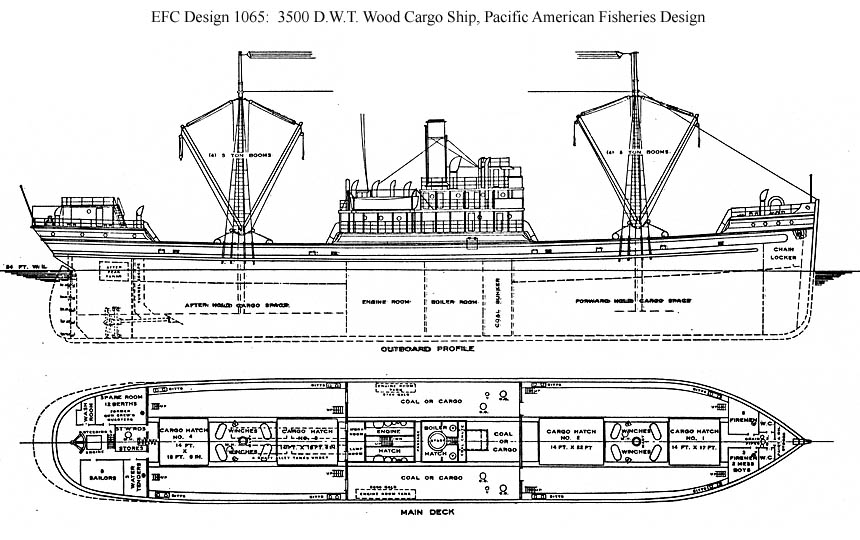
Click here for a larger and more complete copy of this plan: Sheet 1.
Click on the photographs below to prompt larger views of the same images.
|
Notes: Pacific American Fisheries, Inc., a salmon packing company based in Bellingham, Washington, opened a shipyard with two building ways there in 1916. It began by building three wooden steamers for its own use and three for French interests. (Two of its three ships served in the Navy in World War II: for Catherine D. see the YAG-1 page and for Redwood see the AK-39 page.) Following a visit to the yard a Shipping Board official advised the company on 16 April 1917 to expand it from two to five ways to handle the work the company had proposed to undertake when the government was ready to let contracts. The plans and specifications for Ferris's Design 1001 were delivered to the yard in early June, but the yard's design staff took strong exception to it, believing that it was not possible to build a ship of Douglas fir that would stand up to a single large propeller driven by 1,400 horsepower. A yard official explained to a visiting congressional chairman, "You see, this fir softens up." To accommodate the propeller shaft the keelson would have to be cut away in places, weakening it. The company advocated the use of twin screws, with the shafts on each side of the keelson. The Shipping Board allowed the yard to prepare its own design, which it based in part on its first six ships. The yard forwarded its design on 14 June 1917 to the Shipping Board, which had it reviewed in New York by Ferris. Ferris and the yard's treasurer soon met with General Goethals, then manager of the EFC, who complained that the price for the ships was a great deal higher than the bids for the Ferris type. Ferris (according to a yard official) replied that "The ships are superior, and they are worth the difference." The contract was mailed from Washington on 13 July 1917, but the government had changed the financial terms and extended negotiations ensued. Some features of the design inherited from the Ferris specifications were also altered in February 1918 to suit Pacific Coast practice. On 6 February 1918 the yard finally received a telegram that a contract for five ships had been signed, and it laid down the first ship on the same day. If the contract had not gone through the yard indended to build this ship for its own account, but with a flush deck. Two ships were later added. The yard bought the machinery for the ships from the Seattle Machine Works and installed it themselves. They used the less efficient watertube boilers because the preferred Scotch marine boilers were reserved by the EFC for steel ships. (Special sources: August C. Radke, Pacific American Fisheries, Inc., McFarland, 2002; Testimony before the House Select Committee on U.S. Shipping Board Operations, Pacific Coast Activities, 21 August 1919, pages 22-48 and 63-72.) Specifications: Design 1065 (Pacific American Fisheries type). Wood hull. Deadweight tons: 3500 designed. Dimensions: 282.0' oa, 268.3' pp x 46.2' ext (47.2 over fenders/rubbing strakes), 45.2' mld x 26' depth mld, 25' draft load. Propulsion: 2 screws, 2 triple expansion engines, 2 standard water tube boilers, 1500 IHP (two 750 IHP engines), 8.3 knots. Configuration: 2 decks, 2 holds, 4 hatches. |
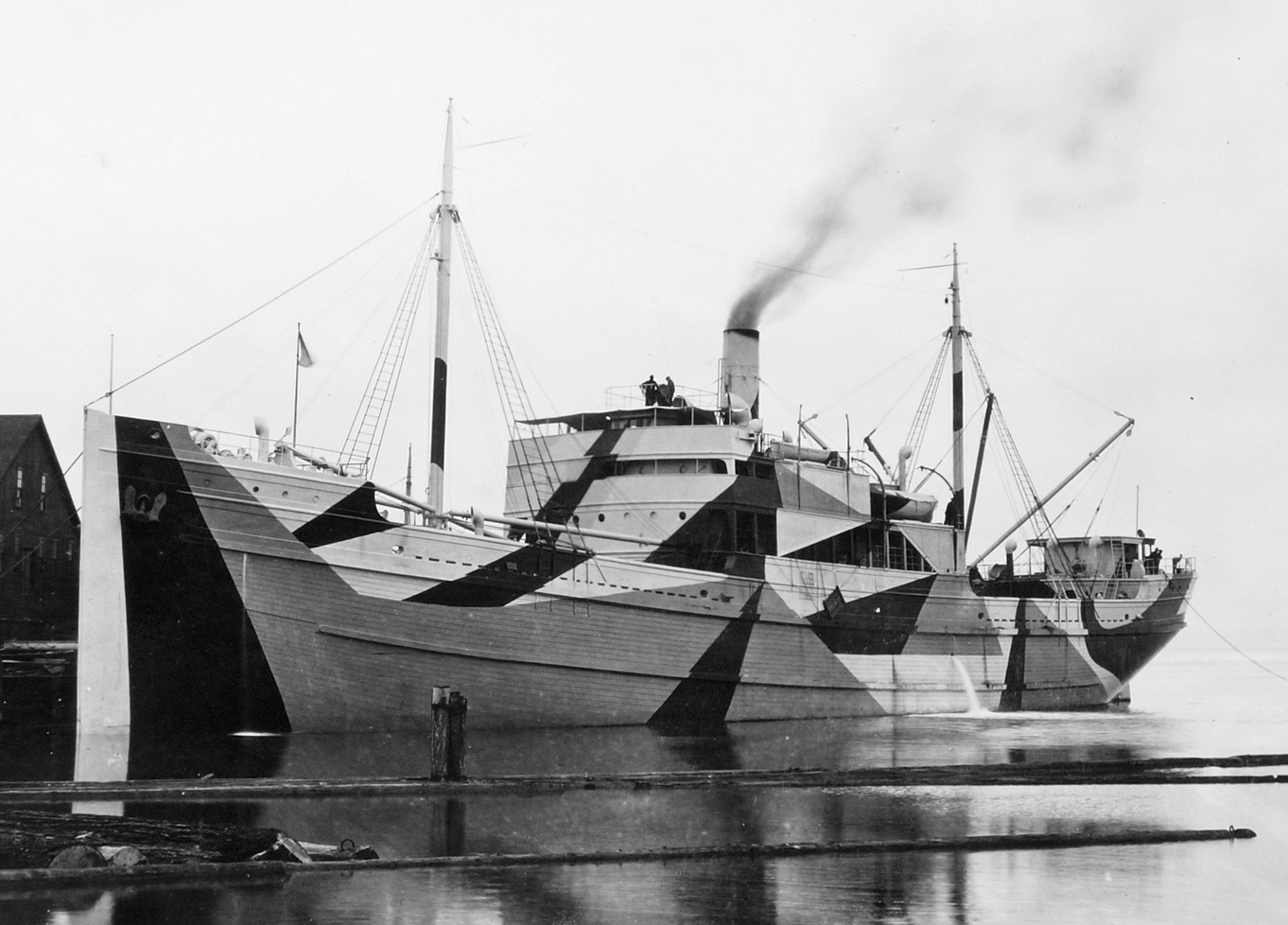
| S.S. Cruso (Design 1065, EFC Hull 1201) on 30 October 1918, one day after making her trial trip and the day that her builder, the Pacific American Fisheries of Bellingham, Wash., declared her "in commission." (NARA: RG-165-EO Album 2-C, Local ID: 165-EO-2C(1)) (Click photo to enlarge) |
|
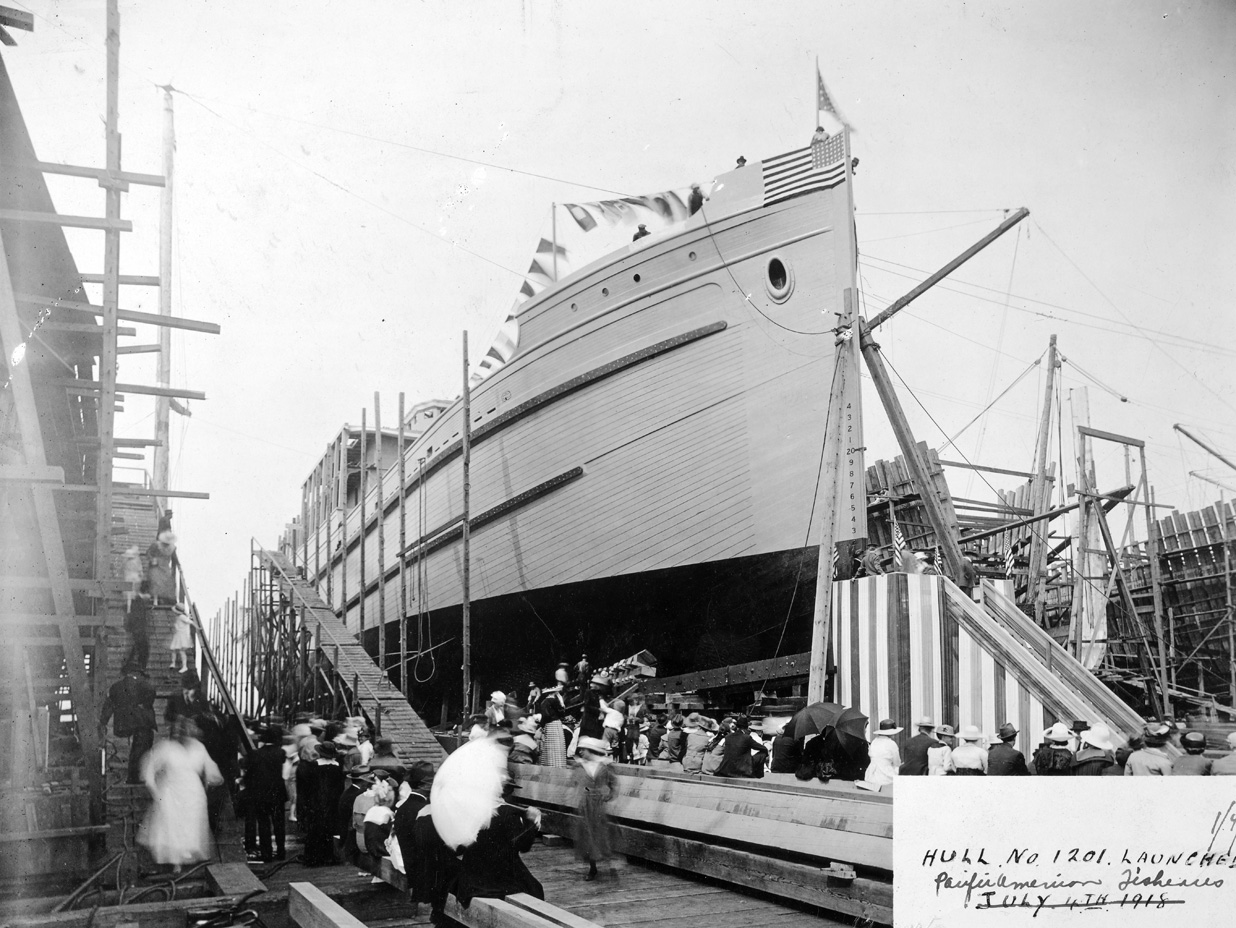
S.S. Cruso (Design 1065, EFC Hull 1201) Just before launching on 4 July 1918. The launch party is on the platform and workers are ready to drive in the wedges that start the launch sequence. Cruso had initially been named Blythedale. Photo No. 165-WW-502D-005 Source: U.S. National Archives, RG-165-WW |
 |
|
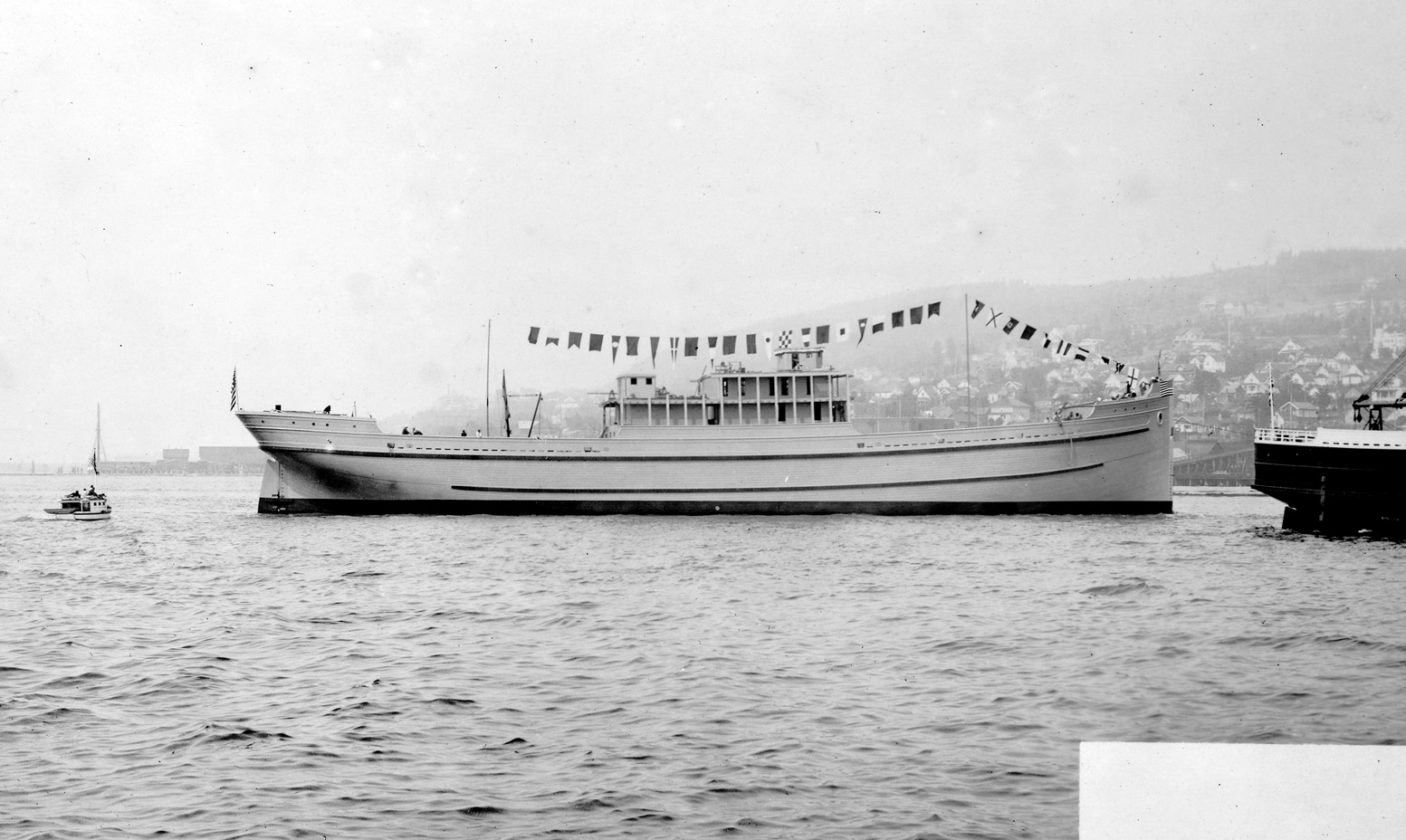
S.S. Cruso (Design 1065, Hull 1201) Just after being launched on 4 July 1918. She made her trial trip on 29 October 1918 and was delivered to the EFC on 9 December 1918. Photo No. 165-WW-503M-057 Source: U.S. National Archives, RG-165-WW |
 |
|
S.S. Bockonoff (Design 1065, Hull 1203) Fitting out afloat at the builder's yard. The superstructure looks mostly complete, but the machinery is not yet on board. She was launched on 1 October 1918, made her trial trip on 6 March 1919, and was delivered to the EFC on 27 March 1919. Photo No. 165-WW-505A-012 Source: U.S. National Archives, RG-165-WW |
 |
|
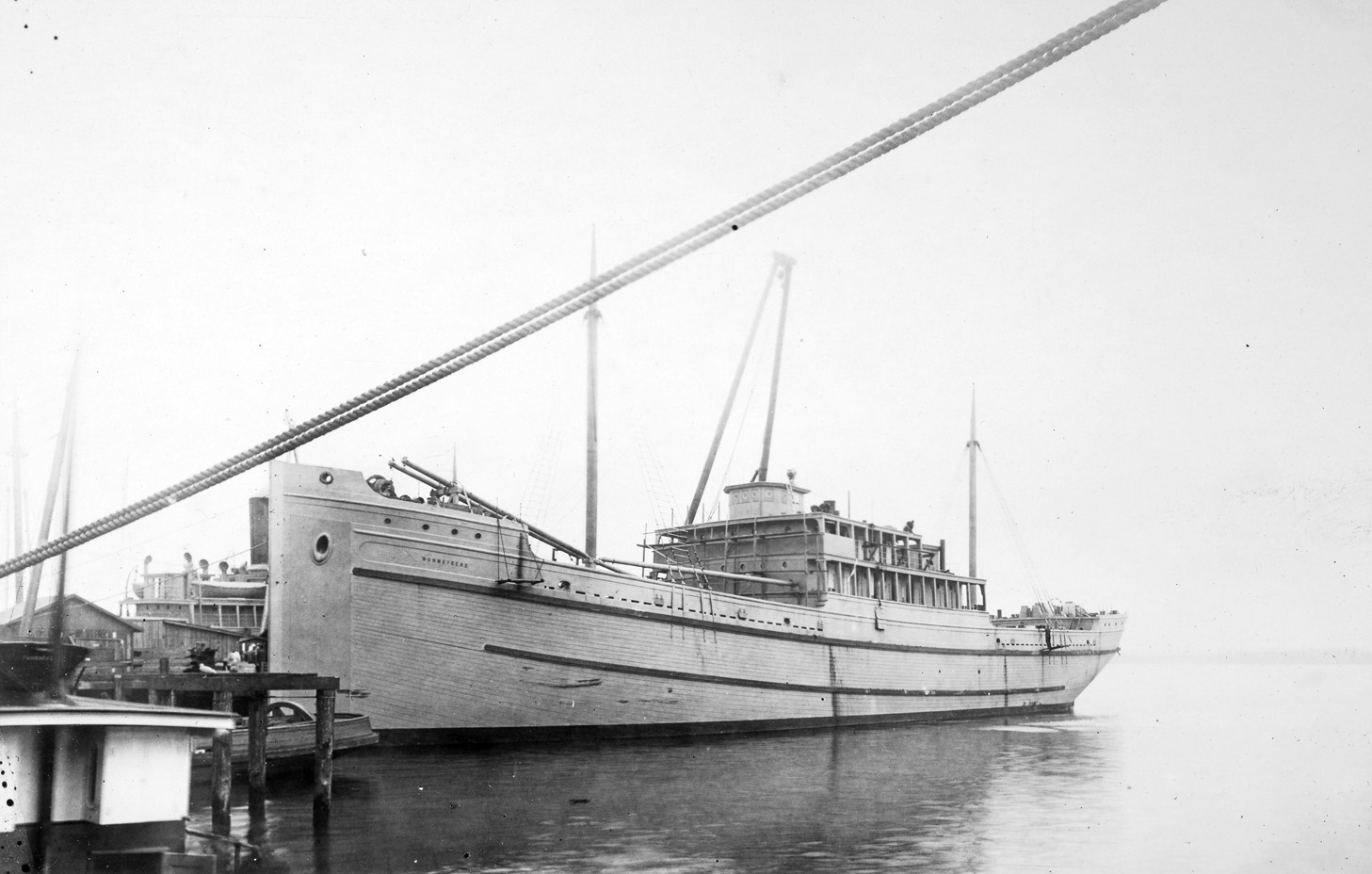
S.S. Bonneteere (Design 1065, Hull 1204) Fitting out afloat at the builder's yard. Behind her bow is a sister which has had her engines installed at the yard. Bonneteere was launched on 2 November 1918, made her trial trip on 6 May 1919, and was delivered to the EFC on 16 May 1919. (Her name appears as "Bonneteere" in the USSB and ABS ship registers even though it may have originated as a typo for "Bonneterre.") Photo No. 165-WW-502D-002 Source: U.S. National Archives, RG-165-WW |
 |