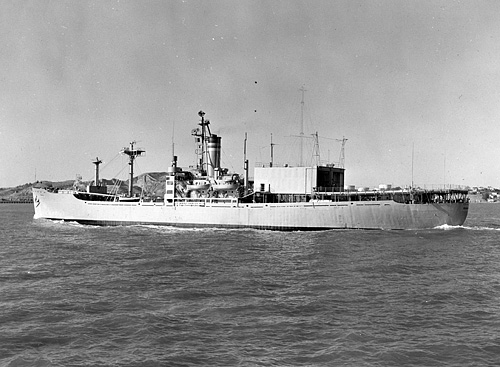
USNS Sunnyvale (T-AGM 5) on 10 April 1964.
Click on this photograph for links to larger images of this class.
Class: LONGVIEW (T-AGM 3, VC2-S-AP3)
Design: MC VC2-S-AP3
Displacement (tons): 4,512 light, 15,200 full
Dimensions (feet): 455' oa, 444' wl x 62' e/wl x 28.5'
Armament: none
Accommodations: 14 officers, 75 unlicensed
Speed (kts.): 17
Propulsion (HP): 8,500
Machinery: Geared steam turbines, 2 boilers (465psi/750deg), 1 screw
Construction:
| AGM | Name | Reclas | Builder | Keel | Launch | Svc |
| 3 | LONGVIEW | 27 Nov 1960 | Permanente Metals #2 | 24 Apr 1944 | 20 Jul 1944 | (Jul 1959) |
| 5 | SUNNYVALE | 27 Nov 1960 | California SB | 8 Apr 1944 | 6 Jun 1944 | (Jul 1959) |
Disposition:
| AGM | Name | T | Inact | Strike | Disposal | Fate | MA Sale |
| 3 | LONGVIEW | T | ca Oct 1974 | 1 Nov 1974 | 4 Nov 1974 | MA | 27 Apr 1976 |
| 5 | SUNNYVALE | T | ca Dec 1974 | 15 Dec 1974 | 9 Jan 1975 | MA | 17 Jul 1975 |
Class Notes:
These ships entered Navy service in 1950 as units of the GREENVILLE VICTORY (T-AK 237) class, and their history before their AGM conversions is described on the page for that class. They were Victory ships of the VC2-S-AP3 type and served as MSTS cargo ships until 1959.
In 1958 the United States initiated its first human spaceflight program, called Project Mercury. Its goal was to put a man into Earth orbit and return him safely, ideally before the Soviet Union did. The flight was designed to be controlled from the ground via the Manned Space Flight Network, a system of tracking and communications stations, although the astronauts had backup controls. Both astronaut and capsule were to be recovered by helicopters deployed from US Navy ships. Six manned Mercury flights between May 1961 and May 1963 were followed by 12 Gemini two-man flights between 1964 and 1966.
In 1959 HAITI VICTORY was converted to a missile range ship by Triple A Machine Shop, Inc., of San Francisco and was on range about July 1959. DALTON VICTORY was similarly conveted by Willamette Iron & Steel Co. of Portland, Ore., and was also on range about July 1959. The two ships were unofficially called "missile tracking and retrieving ships," the large helicopter flight decks and hangars absent from most other missile range ships being for the retrieval mission.
On 11 August 1960, before the ship was renamed, HAITI VICTORY's helicopter retrieved the first object orbited by man in space when it recovered a 300-pound capsule from Discoverer 13, a diagnostic variant that had been launched into orbit the previous day by a Thor-Agena rocket. Ships had been deployed as a backup to the aircraft that were to recover the capsule, and when the capsule missed the planned impact point HAITI VICTORY was able to retrieve it before it sank. Discoverer was the cover name for the Central Intelligence Agency's since-declassified Corona photo-reconnaissance satellite) program. Thirty-seven numbered Discoverer satellites were launched between February 1959 and February 1962. Development was difficult, and the program only achieved its first fully successful flight when Discoverer 14 returned usable imagery of many Soviet targets in August 1960. The Discoverer launches were followed by 145 Corona launches, the last of which occurred in May 1972.
On 29 March 1960 a new version of SECNAV Instruction 5030.1B then in draft established a new classification, AGM, with the meaning "Missile Range Instrumentation Ship," and Commander MSTS asked that HAITI VICTORY, PVT JOE E MANN, and DALTON VICTORY, all missile range ships, be reclassed and assigned appropriate new names. The instruction was promulgated on 25 August 1960, and on 12 September 1960 Commander MSTS alerted his staff that a change of the classification of T-AK 238 (HAITI VICTORY) and T-AK 256 (DALTON VICTORY) to T-AGM 3 and T-AGM 5 was pending in OPNAV. New names were also to be assigned. On 27 October 1960 effective 27 November 1960 SECNAV approved the new classifications AGM 3 and AGM 5 and the names LONGVIEW and SUNNYVALE for these ships.
The two ships subsequently had their antenna outfits modified several times for different programs as shown in the accompanying photographs. Both were declared surplus to MSC requirements in late 1974 and transferred to MA custody for disposal.
Ship Notes:
| AGM | Name | MCV | Notes |
| 3 | LONGVIEW | 532 | Ex HAITI VICTORY (AK 238), compl. 18 Sep 1944. Converted to a missile range ship and on range circa July 1959. Redesignated LONGVIEW (T-AGM 3) effective 27 Nov 1960. Was to be inactivated by MSC on arrival at Oakland, Calif, around 7 October 1974 as surplus to MSC requirements. To MA custody 4 Nov 1974. To buyer 27 Apr 1976. |
| 5 | SUNNYVALE | 21 | Ex DALTON VICTORY (AK 256), compl. 19 Jul 1944. Converted to a missile range ship and on range circa July 1959. Redesignated SUNNYVALE (T-AGM 5) effective 27 Nov 1960. Was to be inactivated by MSC on arrival at Naval Supply Center, Oakland, Calif, around 1 December 1974 as surplus to MSC requirements. To MA custody 9 Jan 1975. To buyer 11 Aug 1975. |
Page Notes:
Compiled: 18 Oct 2021
© Stephen S. Roberts, 2021
Special sources: CIA History Staff (Kevin C. Ruffner, editor), CORONA: America's First Satellite Program,, Washington, D.C., 1995.