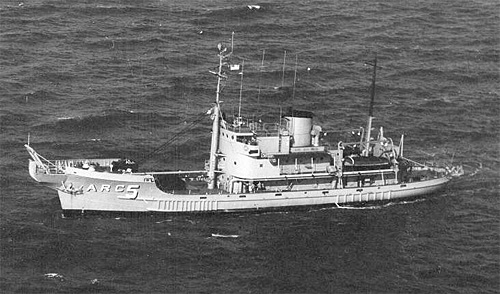
USS Yamacraw (ARC 5) circa the early 1960s.
Click on this photograph for links to larger images of this class.
Class: YAMACRAW (ARC 5, Army MP Design 201)
Design: Army MP Design 201
Displacement (tons): 910 light, 1,315 full
Dimensions (feet): 188.7' oa, 176' wl x 37' wl x 17.75' moulded depth
Armament: none
Accommodations: 11 officers, 54 enlisted
Speed (kts.): 12
Propulsion (HP): 1,200
Machinery: Skinner Unaflow steam reciprocating, 2 boilers (210psi/491deg), 2 screws
Construction:
| ARC | Name | Reacq | Builder | Keel | Launch | Comm |
| 5 | YAMACRAW | 17 Apr 1959 | Marietta Mfg | 1941 | 1942 | 30 Apr 1959 |
Disposition:
| ARC | Name | T | Decomm | Strike | Disposal | Fate | MA Sale |
| 5 | YAMACRAW | 2 Jul 1965 | 1 Jul 1965 | 2 Jul 1965 | MA/T | 18 Oct 1967 |
Class Notes:
The history through 1946 of this ship, an Army Design 201 188-foot twin-screw steel steam-propelled mine planter, is given with the rest of the CHIMO (ACM 1) class in the World War II section of this site. Another six ships of this class were acquired as the CANONICUS (ACM 11) class class in 1949-51.
The Coast Guard acquired USS TRACKER (ACM 9), originally the Army's MAJ GEN ARTHUR MURRAY (MP-9), from the Navy on 20 Jun 1946 and converted her to the cable ship YAMACRAW (WARC 333) to replace its PEQUOT (built 1909, in service 1922-1946). The Woods Hole Oceanographic Institution leased YAMACRAW during 1957-1958 and made 11 cruises in her in the North Atlantic and Mediterranean, mainly for geophysical work and towing a 600' long thermistor chain from a winch on the after deck. Woods Hole returned the vessel in 1959. On 10 April 1959 the Coast Guard authorized the loan of YAMACRAW back to the Navy, which accepted custody of her at New York on 17 April 1959 as a replacement for PORTUNUS (ARC 1) and commissioned her on 30 April 1959. BUPERS intended to man YAMACRAW with PORTUNUS personnel, and maximum use of them was made in the commissioning. CNO on 13 April 1959 directed the overhaul of YAMACRAW with $70,000 of FY 1959 funds previously programmed for PORTUNUS and also directed that the overhaul of PORTUNUS be cancelled and that ship be decommissioned preparatory to disposal on or about 1 May 1959. He also authorized the maximum transfer of equipment and spare parts from PORTUNUS to YAMACRAW.
YAMACRAW operated from Portsmouth, New Hampshire, to Bermuda for the next six years and spent much of her at-sea time conducting research projects for the Office of Naval Research (ONR) and for the Bell Telephone Laboratories. On 22 January 1965 the Commander, Third Naval District, elaborated to CNO that YAMACRAW was assigned to his district for operations in support of the Office of Naval Research and was engaged primarily in ONR underwater sound detection and warfare projects. The ship had capabilities for towing submerged objects and laying and picking up cable up to 2.5 inches in diameter in depths exceeding two miles. When engaged in these operations, YAMACRAW carried civilian scientists and technicians as test supervisors. The majority of the ship's ONR operations were in the Bermuda area.
On 18 January 1965 the Commander, Third Naval District, responding to a suggestion from CNO's office (Op-43), asked CNO to have a material inspection of YAMACRAW scheduled between 24 February and 5 March 1965, a year early, to determine whether the interests of the Navy would best be served by spending funds on improving the material condition of the ship or by replacing her. Pursuing this matter on 29 March 1965, Op-43 explained to his superior, Op-04, that the ship had been accepted by the Navy in a poor material state, that no inspection had been ordered conducted by the INSURV Board, and that repair funds in approximately one-half of the recommended amount had been made available by CNO at the time of acceptance. The inspection conducted in March 1965 "proved conclusively" that personnel hazards and material deficiencies existed beyond those normally found and warranted restricting her operations. On 18 March 1965 Op-43 restricted operations of YAMACRAW to dockside due to her condition. In a conference on 23 March 1959 the President of the INSURV Board had pointed to the lack of even minimal habitability standards on the ship, and the consensus in the meeting was that while the current estimate for an overhaul was $400,000, a more realistic figure would be around $750,000. More importantly, it was noted that the end-users (presumably including ONR) could not establish a firm requirement for the continued use of the ship, indicating that her mission was not critical. The conference concluded that unless a firm requirement was established the ship should be removed from the Navy inventory, partly in response to the Op-09 Personnel Reductions initiative. Funds scheduled for her were diverted to BUTTERNUT (AN 9), which was scheduled to be deleted from the active fleet during FY 1966 but for which there was an urgent requirement for continued torpedo (MK-46 and MK-48) testing services.
Ship Notes:
| ARC | Name | MA | Notes |
| 5 | YAMACRAW | Ex TRACKER (ACM 9), ex Army MAJ GEN ARTHUR MURRAY (MP-9), completed ca. Nov 1942. Decomm. and to USCG 20 Jun 1946, stk. 19 Jul 1946, and converted by Coast Guard to cable layer YAMACRAW (WARC-333). Decomm. by USCG 16 Apr 1959, loaned indefinitely to Navy same date, Navy took custody the next day, and ship commissioned 30 Apr 1959 as USS YAMACRAW (ARC-5). Remained on USCG list while in use by Navy. Decomm. and administratively returned to USCG 1 Jul 1965, to MA 2 July 1965 for disposal. Scrapped by 1 May 1968. |
Page Notes:
Compiled: 16 May 2022
© Stephen S. Roberts, 2022