 Return to WWI Auxiliaries.
UNITED STATES NAVY
TEMPORARY AUXILIARY SHIPS
WORLD WAR I
TEMPORARY AUXILIARY SHIPS
WORLD WAR I
Online Library of Selected Images:
-- U.S. NAVY SHIPS --
USS President Lincoln (1917-1918) --
Sinking, 31 May 1918
On the morning of 31 May 1918 the 32,500 ton (displacement) transport USS President Lincoln was steaming about 600 miles from Brest, France, bound for the United States after delivering a load of American military personnel earlier that month. 715 persons were on board, mainly ship's crew but with about 30 Army officers and men, some of whom were sick and two totally paralyzed. She was accompanied by three other Navy transports, Antigone, Rijndam and Susquehanna, steering a zig-zag course in line-abreast formation. They had left Brest two days earlier, convoyed by destroyers, but were now proceeding unescorted since the zone of most serious submarine threat had been left behind.
Just before 9 A.M. the German submarine U-90, which had been tracking the convoy for several hours, hit President Lincoln's port side near the bridge with two torpedoes, immediately killing seven men working below decks. Shortly afterwards a third torpedo struck further aft. The ship was now rapidly settling, and her Commanding Officer ordered her abandoned by all but the crews of her four six-inch guns. These remained on board, and kept firing, until President Lincoln was close to sinking, in the hope that the submarine might surface and present a target. All but those killed by the torpedo explosions had gone into the water by the time she sank at about 9:30, but three officers and sixteen crewmen were unable to get clear and were drowned.
President Lincoln's 689 survivors, including the two paralyzed Soldiers, were now adrift in her boats and life rafts. The other three transports, in accordance with standard procedure in such cases, had continued on their way, though a radio message had been transmitted reporting the sinking. About an hour after the initial torpedoing, U-90 emerged and approached the boats and rafts, searching for a senior officer who might provide intelligence. Despite an effort to remain unrecognized, Edouard V.M. Isaacs was discovered and made a prisoner. His heroic conduct during the subsequent five months was later recognized by the award of the Medal of Honor.
Once the submarine had left the vicinity, President Lincoln's boats and rafts were collected and lashed together in order to minimize the chances of further loss of life. During the night the destroyers Warrington and Smith (DD-17) arrived and took everyone on board, a considerable crowd on two ships of such modest size. While en route back to France, they encountered U-90, attacking her with depth charges, but causing no damage. The survivors of USS President Lincoln arrived back at Brest on 2 June 1918. Their ship was the largest U.S. Naval vessel to be lost in the First World War.
This page features all available views concerning the loss of USS President Lincoln on 31 May 1918.
For more images related to the loss of this ship, see:
For other pictures concerning this ship, see:
Click on the small photograph to prompt a larger view of the same image.
|
Photo #: NH 103354 USS President Lincoln (1917-1918) Photographed by the wireless operator of USS Rijndam (ID # 2505) just after she was torpedoed on 31 May 1918. The radioman was then sending out an "S-O-S" message. President Lincoln sank about a half-hour later. The original print has been retouched to emphasize the smoke issuing from her stack. Courtesy of the Naval Historical Foundation, Washington, D.C. - USS President Lincoln Collection. U.S. Naval Historical Center Photograph. Online Image: 74KB; 740 x 540 pixels |
 |
|
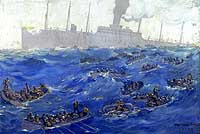
Photo #: NH 86494-KN (Color) USS President Lincoln (1917-1918) Painting by Fred Dana Marsh, 1920, depicting the ship sinking after she was torpedoed by the German submarine U-90 on 31 May 1918. Twenty-six lives were lost with her, and one officer was taken prisoner. Courtesy of the U.S. Navy Art Collection, Washington, DC. U.S. Naval Historical Center Photograph. Online Image: 75KB; 740 x 520 pixels |
 |
|
Photo #: NH 103275 Sinking of USS President Lincoln, 31 May 1918 Life boats and rafts adrift with survivors on board, after President Lincoln was torpedoed and sunk by the German submarine U-90. Courtesy of the Naval Historical Foundation, Washington, D.C. - USS President Lincoln Collection. U.S. Army Signal Corps Photograph, from the collections of the Naval Historical Center. Online Image: 51KB; 740 x 470 pixels |
 |
|
Photo #: NH 103360 Sinking of USS President Lincoln, 31 May 1918 Life boats and liferafts full of survivors, after President Lincoln was torpedoed and sunk by the German submarine U-90. The boats appear to be towing the rafts. Courtesy of the Naval Historical Foundation, Washington, D.C. - USS President Lincoln Collection. U.S. Army Signal Corps Photograph, from the collections of the Naval Historical Center. Online Image: 65KB; 740 x 470 pixels |
 |
|
Photo #: NH 2758 USS President Lincoln (1917-1918) Some of the ship's survivors on board USS Warrington (Destroyer # 30), which rescued them after President Lincoln was sunk on 31 May 1918. At least one of these men (lower left center) is a British Soldier. Note the lifejackets worn by everyone present. Courtesy of Captain Percy Foote, USN, 1931. U.S. Naval Historical Center Photograph. Online Image: 131KB; 740 x 615 pixels |
 |
|
Photo #: NH 41725 Sinking of USS President Lincoln, 31 May 1918 Some of the ship's survivors aboard USS Warrington (Destroyer # 30) soon after they were rescued. These men are still wearing life preservers. The three in the front center are U.S. Army officers. President Lincoln was torpedoed and sunk by the German submarine U-90. Note Warrington's bell in the upper left center. U.S. Army Signal Corps Photograph, from the collections of the Naval Historical Center. Online Image: 110KB; 740 x 580 pixels |
 |
|
Photo #: NH 77160 Sinking of USS President Lincoln, 31 May 1918 Survivors on board USS Warrington (Destroyer # 30), at left, and USS USS Smith (Destroyer # 17), at right, after they were rescued, about 1 June 1918. The donor, a member of Warrington's crew at the time, comments: "We had to transfer some men to the Smith as we had too many men to feed." Courtesy of Gustavus C. Robbins, 1973. U.S. Naval Historical Center Photograph. Online Image: 76KB; 740 x 430 pixels |
 |
|
Photo #: NH 41723 Sinking of USS President Lincoln, 31 May 1918 Some of President Lincoln's survivors after they were rescued. She was torpedoed and sunk by the German submarine U-90. This is a halftone reproduction. U.S. Army Signal Corps Photograph, from the collections of the Naval Historical Center. Online Image: 129KB; 740 x 605 pixels |
 |
|
Photo #: NH 41894 USS President Lincoln (1917-1918) "All that was left of the ship": Life rafts and boats adrift in the Bay of Biscay about two weeks after the ship was sunk. President Lincoln was torpedoed by the German submarine U-90 on 31 May 1918. Note: A hand-written inscription on an original print of this image in the Naval Historical Foundation's USS President Lincoln collection identifies it as having been taken from USS Roe (Destroyer # 24) on 1 June 1918, the day after President Lincoln was sunk. Courtesy of Captain Percy Foote, USN, 1931. U.S. Naval Historical Center Photograph. Online Image: 92KB; 740 x 495 pixels |
 |
|
Photo #: NH 41724 Sinking of USS President Lincoln, 31 May 1918 Some of the ship's survivors going on board USS Great Northern at Brest France, circa June 1918. President Lincoln was torpedoed and sunk by the German submarine U-90. U.S. Army Signal Corps Photograph, from the collections of the Naval Historical Center. Online Image: 87KB; 740 x 600 pixels |
 |
|
Photo #: NH 103361 USS President Lincoln (1917-1918) Ship's officers and crew at Bensonhurst, Brooklyn, New York, on 20 June 1918, prior to reassignment. Photographed by Frank Holland, Brooklyn, N.Y. President Lincoln had been torpedoed and sunk on 31 May 1918. Courtesy of the Naval Historical Foundation, Washington, D.C. - USS President Lincoln Collection. U.S. Naval Historical Center Photograph. Online Image: 173KB; 1200 x 480 pixels |
 |
For more images related to the loss of this ship, see:
For other pictures concerning this ship, see:
 Return to WWI Auxiliaries.
Page made 30 November 2005
Page divided and new images added 28 December 2005