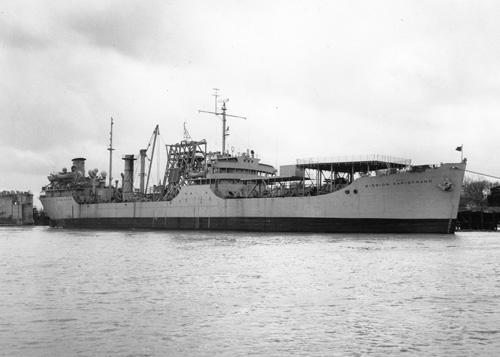
USNS Mission Capistrano (T-AG 162).
Click on this photograph for links to larger images of this class.
Class: MISSION CAPISTRANO (T-AG 162)
Design (before AG modifications): MC T2-SE-A2
Displacement (tons): 5,630 light, 21,880 full
Dimensions (feet): 524' oa, 503' wl x 68' e x 30' max nav
Armament: none
Accommodations: 11-13 officers, 34-36 unlicensed
Speed (kts.): 16
Propulsion (HP): 10,000
Machinery: Turbo-electric, 2 boilers (600psi/825deg), 2 screws
Construction:
| T-AG | Name | Reclas | Builder | Keel | Launch | Svc |
| 162 | MISSION CAPISTRANO | 1 Jul 1960 | Marinship | 29 Feb 1944 | 7 May 1944 | (Jul 1960) |
Disposition:
| T-AG | Name | T | Inact/Cust | Strike | Disposal | Fate | MA Sale |
| 162 | MISSION CAPISTRANO | T | 15 Sep 1970/C | 19 Oct 1971 | 1 Sep 1971 | MA/T | 10 Jul 1972 |
Class Notes:
This ship entered Navy service in 1947 as a unit of the MISSION BUENAVENTURA (T-AO 111) class, and her history before her AG conversion is described on the page for that class.
MISSION CAPISTRANO (T-AO 112) was diverted to special duty in 1959 for Project ARTEMIS. Project ARTEMIS was to consist of transporting a 500-ton sonar transducer from the Gulf Coast where it was made to Bermuda, first testing it there in a mobile mode, and then fixing it to the bottom in 1,200 feet of water and supplying power to it for a period between six months and two years. In July 1959, before commencing this duty, she was assigned to assist in the movement of a 104-foot long FPS-28 SAGE air defense radar antenna from the Raytheon test center in Sudbury, Mass., to the Houma Air Force Base in Louisiana. The antenna was moved by highway to Quincy, Mass., and loaded on the ship as deck cargo for transportation to New Orleans. In the meantime BUSHIPS developed its initial specifications for a T2 tanker conversion on 28 August 1959. On 9 October 1959 a conference was held at BUSHIPS on converting the ship for her work with ARTEMIS. NSY Philadelpha was to carry out the conversion. The primary power supply for the transducer was to be a Clark Elliott 8,000 KW gas turbine generator, with the ship's turbo-electric main propulsion generator as a backup. The ship was to be available in Norfolk on 16 October 1959 and the estimated completion date (probably for the design) was 15 December 1959. On 7 January 1960 a contract for the conversion was awarded to Avondale Marine Ways.
On 6 May 1960 Commander MSTS informed CNO that USNS MISSION CAPISTRANO was then undergoing modification for participation in Project ARTEMIS. The extensive redesign of the ship would preclude her future use as a tanker without extensive reconversion. The duration of the project was assumed to be about two years (she actually served to 1970) and there was then no foreseen requirement for restoration of her original characteristics. Accordingly MSTS recommended that the identifying classification be changed from T-AO to T-AG effective 1 July 1960.
On 26 October 1960 MISSION CAPISTRANO was in drydock at the Todd Pacific Shipyards at New Orleans for completion of the well through which the transducer was to be lowered with its doors and bottom doubler plates. The gas turbine generator for the transducer was delivered on 29 October 1960 and the installation of the transducer array structure was completed on 4 March 1961 at Avondale. The first two modules of the array were installed at Todd on 15 March 1961, and tests were conducted in the Gulf of Mexico to a 1,248 depth on 1 April 1961. The ship arrived at Norfolk on 12 April 1961 "for corrections to project equipment." Thirteen more modules were installed at Newport News in August 1961.
According to ONR's Naval Research Reviews of August 1961 quoting with updates a Navy press release of 31 May 1961, "a modified Navy tanker and a new Texas-type tower have joined the Navy's Project ARTEMIS. This project is an exploratory development effort, sponsored by the Office of Naval Research, to determine the feasibility of using a large transducer ... and high-gain receivers, together with advanced data-processing equipment, for submarine detection. This particular concept was proposed by Dr. Frederick V. Hunt, a Harvard professor, in 1951. In recognition of his work, the project was named after Artemis - Greek goddess of the hunt. The former T2 class Navy tanker is the USNS MISSION CAPISTRANO which has recently undergone extensive modifications to fit her for her new role. Aft of her bridge she now contains a large well for stowing and lowering and raising the giant transducer (five stories high) and associated equipment in and out of the water.... Below decks, the space formerly occupied by seven large tanks is now used to stow the power supply and auxiliary equipment for the transducer.... The Texas-type tower, built in 1960 under the direction of the Bureau of Yards and Docks and named the "Argus Island," is located in 190 feet of water above an extinct volcano about 30 miles south of Bermuda." The purpose of the program was to determine the feasibility of active acoustic ocean surveillance to locate submarines at very long range in large ocean areas, with the Texas-type tower serving as a relay point for hydrophones (receivers) placed on the ocean floor. MISSION CAPISTRANO operated as the active sonar transmitting source, primarily in the area north of the Bahamas to Cape Hatteras and Bermuda.
A bow thruster was installed at Bethlehem Steel, Baltimore, on 29 March 1962 to help control the positioning of the ship. On 20 September 1962 MISSION CAPISTRANO took time out to load an experimental nuclear powered navigational beacon at Bayonne, N.J., which she then placed on the ocean bed 700 miles off the coast of Jacksonville, Fla. On 3 November 1962 the transducer array was removed at NSY Philadelphia "to make the ship available for other work." The array was reinstalled at Philadelphia on 21 March 1963. In April 1963 MISSION CAPISTRANO participated in the search off Portsmouth, N.H. for the new nuclear submarine USS THRESHER (SSN 593) which had just been lost on sea trials. Installation of the top row of five modules was begun in April 1964 and the complete acoustic source with all 20 modules was tested in the Northwest Providence Channel in the Bahamas during July 1964. It was then decided that the transducer array for the acoustic source was not to be installed on the bottom, allowing removal of the helicopter platform forward and the pipe rack for the drilling rig just aft of it to starboard. It was also found that the gas turbine generator was not needed for the existing array, the ship's main steam turbine generator sufficing, though it might be needed for an improved version of the array that was on order. The final report for Project ARTEMIS was submitted on 28 December 1966. MISSION CAPISTRANO continued to experiment with her array, and in October 1966 a contract was awarded to Todd Shipyards Corp., New York, to fit two computer-controlled propulsion pods, one forward of the bridge and one forward of the after house, that could be lowered below the keel to provide improved position-keeping. MISSION CAPISTRANO completed her final operations on 12 July 1970. Ultimately the SOSUS (CAESAR) program which used passive rather than active acoustic surveillance was adopted instead of the active ARTEMIS system.
Ship Notes:
| T-AO | Name | MC | Notes |
| 112 | MISSION CAPISTRANO | 1819 | Ex MISSION CAPISTRANO (T-AO 112), completed 14 Jun 1944. Converted 1960 to a "Sound Testing Ship" by Todd, New Orleans, reclas AG 162 1 Jul 1960. To MA custody 15 Sep 1970. Sold 10 Jul 1972 in scrap sale for non-transportation use, to buyer 7 Dec 1972, renamed CAPISTRANO, resold 15 Mar 1973 and converted to drilling rig. Renamed MISSION EXPLORATION 1975. BU 25 Jun-31 Aug 1980 at Brownsville. |
Page Notes:
Compiled: 3 Nov 2023
© Stephen S. Roberts, 2023
Special sources: NARA: RG 19 Entry UD 1024-S Box 1 (Code 434 workshop unit files); Naval Research Reviews, August 1961, pages 26-28 (online PDF pp. 271-73); three NRL reports at apps.dtic.mil/sti/tr/pdf/ADA035001.pdf (8 Mar 1962), apps.dtic.mil/sti/pdfs/AD0366593.pdf (15 Sep 1965), and apps.dtic.mil/sti/pdfs/AD0384324.pdf (7 Sep 1967).